HARVARD UNIVERSITY. HARVARD INSTITUTE FOR INTERNATIONAL DEVELOPMENT (HIID)
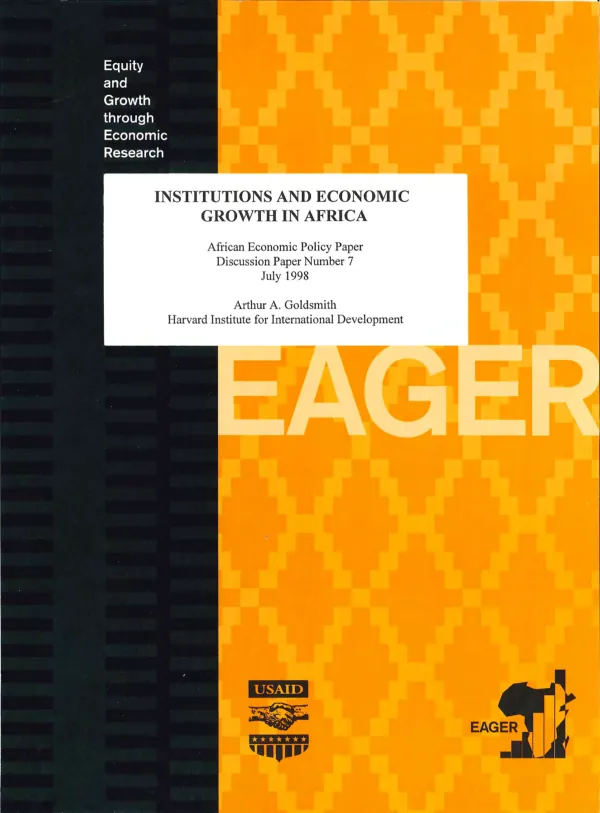
Institutions and economic growth in Africa
Institutional shortcomings contribute to sub-Saharan Africa"s dismal economic performance.
Goldsmith, Arthur A. · 1998
Sign in to readA free account is required to download.
Abstract
These shortcomings are government or "non-market" failures, the corollary of market failures in the private sector. Governments fail by sins of commission and omission. The latter, too infrequently studied, are of particular importance, since African states must not only refrain from inappropriate activities, but improve their behavior toward citizens and create a market-augmenting institutional framework. Regrettably, it is a daunting task to break the mold of public institutions that have hardened around personalized power, arbitrary and unaccountable decisionmaking, widespread dishonesty, and repression of dissent. Three institutional factors stand out as critical to improved public institutions in sub-Saharan Africa: interest groups, the state"s representative and bureaucratic organs, and the political leadership. Interest groups with a stake against economic reform have been an impediment in many countries. State intervention in the economy has created economic rents, which officials use to maintain a patronage network of friends and followers, which, in turn, is used to retain power. However, raw economic interests alone do not determine what public policies are executed. The way the state"s representative and bureaucratic institutions channel those interests is essential in understanding how African economies have developed. Yet, at least in sub-Saharan Africa, these institutions usually lack capacity for decisive action. Part of the solution is more public involvement in decisionmaking -- the region"s democratic experiments are too often centralized and top-down. Finally, leadership is a critical factor in sustained economic reform. Political leaders always enjoy a measure of freedom in choosing policies, and, in much of Africa, their maneuvering room may be particularly wide because of the absence of effective countervailing political forces. Leadership is also critical in fighting corruption, which has been a major issue in sub-Saharan Africa. The region has been poorly led in most cases, with a few hopeful exceptions in recent years. Until institutions grow more fit through a combination of wider interest group representation, more democratic political and bureaucratic processes, and enhanced leadership, they will continue to thwart economic reforms in sub-Saharan Africa. (Author abstract)
Related documents