USAID DEC
Integrated rural development (IRD) evaluation with special reference to Save the Children"s (SCF) community-based IRD project (635-0217)
Sign inUSAID. MISSION TO THE GAMBIA
Integrated rural development (IRD) evaluation with special reference to Save the Children"s (SCF) community-based IRD project (635-0217)
Evaluates community-based integrated rural development (CBIRD) in The Gambia with special reference to women"s roles and to Save the Children Federation"s (SCF) CBIRD project.
Ames, Meri · 1970
Sign in to readA free account is required to download.
Abstract
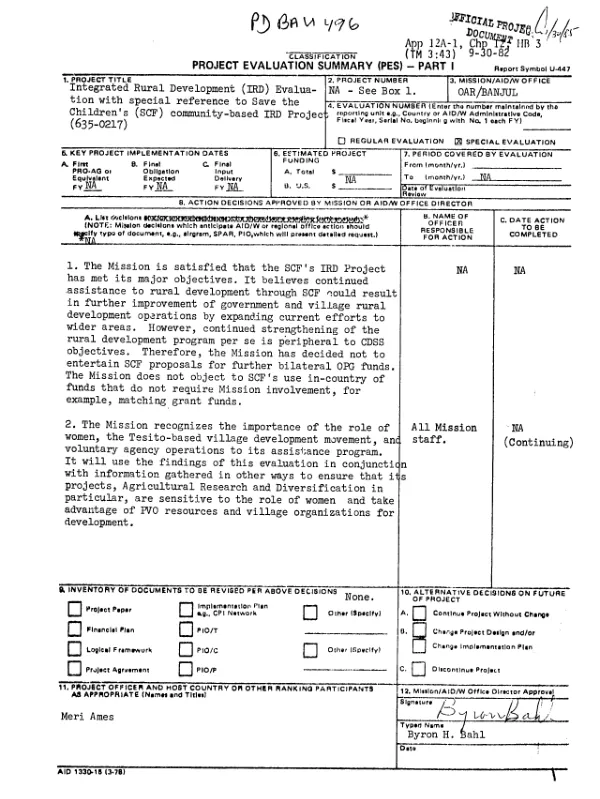
Special PES covers 12/81-8/84 and is based on documentation, site visits, and interviews with Village Development Committee (VDC) members, Community Development Assistants (CDA"s), and personnel of the Government of The Gambia (GOTG) and of various nongovernmental organizations (NGO"s). The GOTG"s TeSito (self-help) village development program, which depends on cooperative inputs from villagers in planning, funding, labor, and supplies, has proven successful, although it cannot compete with programs that offer food for work or supplemental feeding. In supporting TeSito, some NGO"s work with GOTG extensionists such as CDA"s and Home Craft Assistants (HCA"s); others depend on their own field workers. CDA"s and HCA"s working on the SCF project are meeting their objectives more rapidly and with greater success than are their peers in other NGO projects. Women"s groups are actively implementing TeSito projects; their increased participation in rural development is already influencing land tenure, financial control, and community planning (although women still have limited decisionmaking power within their communities). The groups are growing stronger and demanding more sophisticated assistance, such as access to financial, technical, and agricultural resources, from GOTG and NGO"s. Their principal needs are for water, labor-saving implements, vegetable storage and marketing facilities, education and training in literacy and income-generating skills, and improved access to agricultural inputs. Lessons learned are: (1) NGO"s must work with the central VDC in each village, rather than independently or with civil servants who may be transferred (strengthening VDC"s is a major SCF objective); (2) NGO field extension agents must receive inservice and on-the-job training in project management, organization, and technical skills (SCF training of CDA"s and HCA"s has been very effective in this area); (3) community development efforts can effectively address certain basic development problems requiring a combination of a new technology and community action, as long as viable VDC"s and trained CDA"s are present.
Related documents