USAID DEC
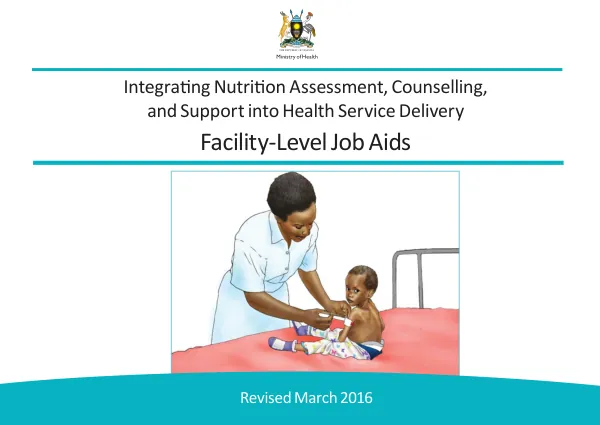
Integrating Nutrition Assessment, Counselling, and Support into Health Service Delivery: Facility-Level Job Aids
Sign inCARE
Integrating Nutrition Assessment, Counselling, and Support into Health Service Delivery: Facility-Level Job Aids
The Ministry of Health in Uganda has developed a set of facility-level job aids to integrate nutrition assessment, counselling, and support into health service delivery.
2016 · 19 pages
Sign in to readA free account is required to download.
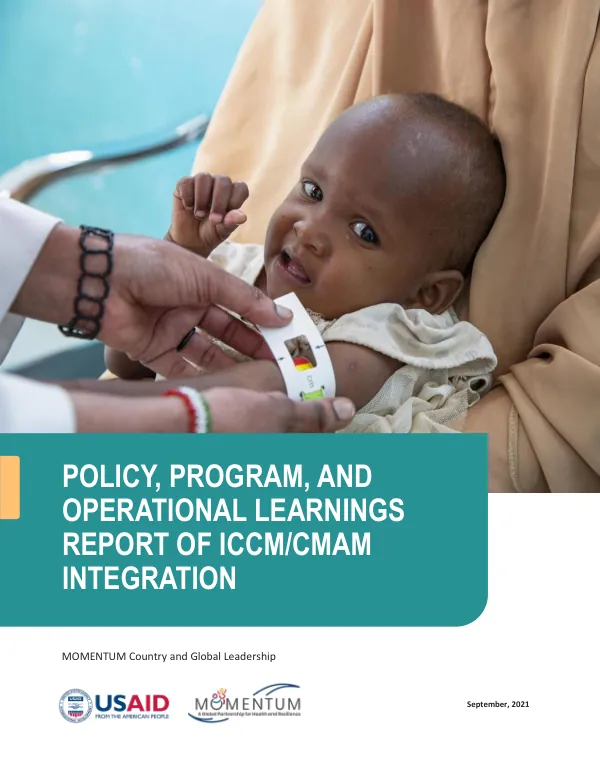
Abstract
The job aids are designed to provide health workers with the necessary tools and guidance to identify and address malnutrition in children, adolescents, adults, and pregnant and lactating women. The job aids are divided into several cards, each focusing on a specific aspect of nutrition care and support. Card 1 outlines the role of a community resource person in creating awareness, counselling, assessing, referring, and following up with clients. The card includes illustrations of various scenarios, such as a community resource person speaking to a group of families and a staff person measuring a child's arm. Card 2 focuses on the role of a facility-level health worker in consulting referral cards, assessing clients, conducting appetite tests, and reporting on nutrition status. The card includes illustrations of a staff person consulting a referral card and measuring a child's arm. Card 3 and Card 4 are similar to Card 1 and Card 2, but focus on nutrition care and support for adolescents, adults, and pregnant and lactating women. The cards include illustrations of various scenarios, such as a community resource person speaking to a group of families and a staff person measuring a woman's arm. Card 5 provides guidance on using a MUAC (mid-upper arm circumference) tape for nutrition assessment. The card explains that MUAC is a simple tool to measure a person's nutrition status and that there are five different tapes for five age groups. Each MUAC tape has the same colour coding, which is used to determine the nutrition status of the individual. Card 6 identifies the target groups for MUAC measurement, including infants from 6 months and children, adolescents and adults, pregnant and postpartum women, and children under 6 months. Card 7 provides step-by-step instructions on how to accurately use a MUAC tape. The card includes illustrations of a staff person conducting each step of measuring a child's arm, from bending the arm at an angle of 90 degrees to reading the cm measurement in the window of the tape. Card 8 provides guidance on how to assess for bilateral pitting oedema, a condition that is of nutritional significance only if it is bilateral and starts from the feet. The card explains that oedema can be graded using a simple test, where firm pressure is applied to the feet for 3 full seconds and then removed. If a depression persists on both feet, it indicates that the patient has bilateral pitting oedema. The job aids are designed to be used by health workers in Uganda to provide nutrition care and support to vulnerable populations. The job aids are a valuable resource for health workers, providing them with the necessary tools and guidance to identify and address malnutrition in their communities.