INTERNATIONAL RESCUE COMMITTEE
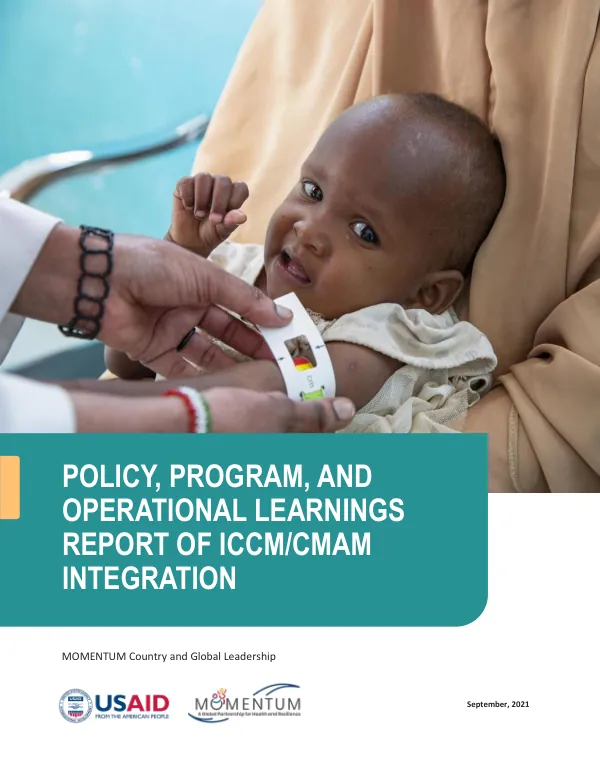
Policy and Program Learnings Report of iCCM/CMAM Integration
Severe wasting management has evolved over the past two decades from facility-based to outpatient, community-based management of acute malnutrition (CMAM) where treatment is provided by trained community health workers (CHWs).
2021 · 39 pages
Sign in to readA free account is required to download.
Abstract
CMAM is proven effective for treating children with uncomplicated cases of severe acute malnutrition (SAM) or severe wasting in the community; however, only about one-third of children with SAM are able to access treatment. Integrated community case management (iCCM) is a strategy that equips CHWs with necessary skills such as nutrition assessment and counseling for sick children of families with limited access to health facilities, in order to treat and prevent common childhood illnesses. The integration of treatment of uncomplicated severe wasting with iCCM improves treatment coverage and cure rates of severe wasting. Prior reviews and country experiences demonstrated that addressing implementation challenges, such as increased workload of CHWs and supply chain management of ready-to-use therapeutic food (RUTF), is essential to ensure successful integration. RUTF supply management provides unique programmatic challenges, and integration of RUTF into national supply chains and essential drug lists, supply and logistics planning, and monitoring is essential to ensure consistent supply and minimal stock-outs. Community engagement is a critical component of the CMAM approach, and includes community sensitization and outreach to ensure ownership and involvement of the community at all stages. Lack of community engagement is seen to contribute or lead to significant barriers in service access and coverage, and addressing these through community engagement can help to remove them. Simplified approaches and adaptations to CMAM provide the opportunity to facilitate an integration of CMAM into iCCM. Multiple approaches are currently being tested and reviewed, such as the use of only one therapeutic product, family-led mid-upper arm circumference (MUAC) screening, and modified dosage of RUTF. Policy-level considerations for integration of CMAM into iCCM include the human resource capacity development, financing considerations, and quality of care (QoC). Human resource capacity development is essential to ensure that CHWs have the necessary skills and knowledge to provide quality care. Financing considerations are critical to ensure that the integration of CMAM into iCCM is sustainable and that CHWs are adequately remunerated for their services. Quality of care is also essential to ensure that CHWs provide high-quality care to children with severe wasting. The integration of CMAM into iCCM requires a comprehensive approach that addresses programmatic and policy-level considerations. A successful integration will require a strong commitment from governments, donors, and implementing partners to ensure that CHWs have the necessary resources and support to provide quality care to children with severe wasting. The integration of CMAM into iCCM has the potential to improve treatment coverage and cure rates of severe wasting, and to reduce the burden of severe wasting on families and communities.
Related documents