USAID. MISSION TO BOLIVIA
Interactive radio learning
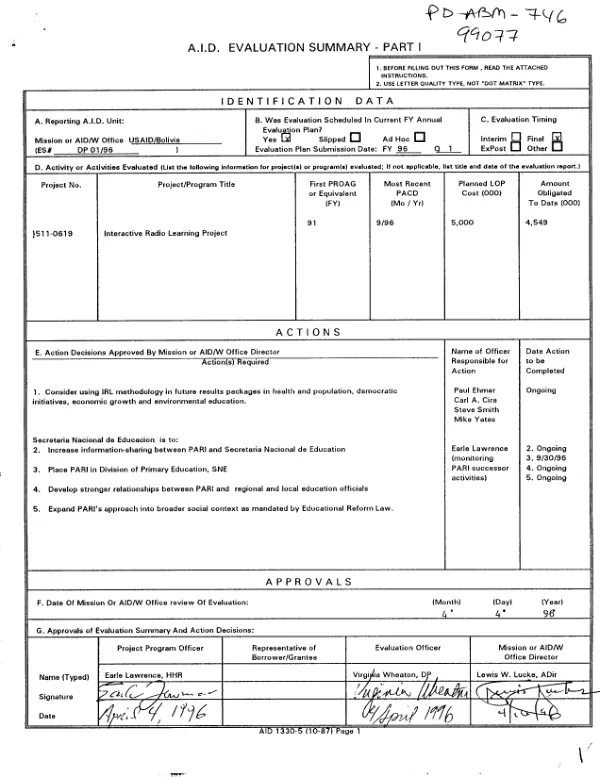
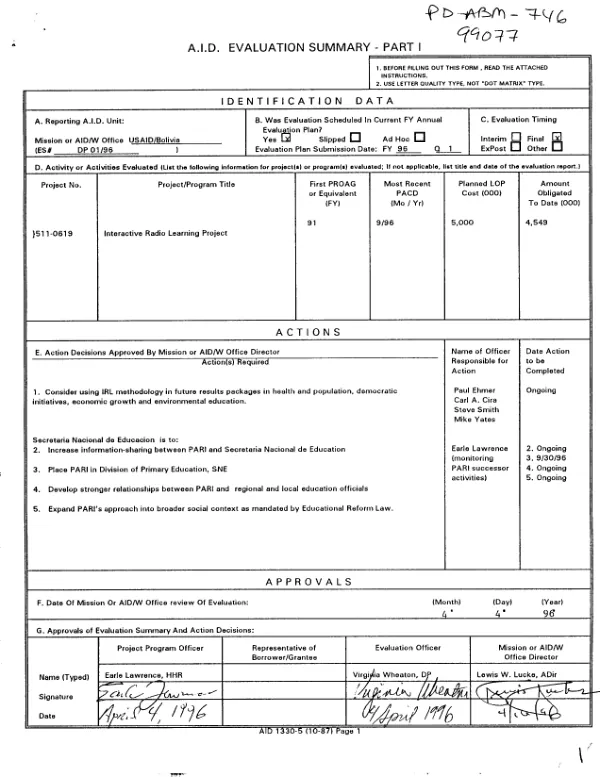
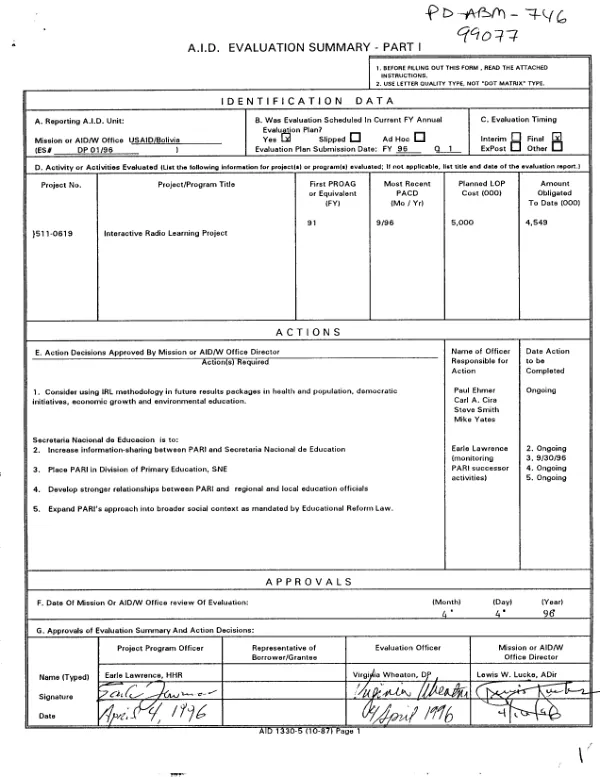
Project, follow-on to 5110597, to institutionalize the use of interactive radio instruction (IRI) to improve health and math education in Bolivia"s basic education system.
1991
Sign in to readA free account is required to download.
Abstract
The Ministry of Education and Culture (MEC) will implement the project with help from a U.S. contractor, Education Development Center, Inc. (EDC). The project will (1) institutionalize math curricula for grades 2-5; (2) develop a health curriculum for grades 3-5; (3) conduct related monitoring and evaluation; and (4) extend IRI to out-of- school children and adults. The IRI math curriculum developed under project 5110597 for grades 2-3 will be institutionalized in at least 7 of the country"s 9 departments. A key activity in this process will be the development of a multiplier-type training of trainers program in which PVO subcontractor instructors will train MEC supervisors and teachers in IRI methodology; the latter will in turn train school directors, who will in their turn be responsible for training additional teachers. Additional outputs include teachers" guides; agreements with radio stations for transmitting the lessons; a system for distributing and maintaining radios; and training of supervisors in evaluation of the IRI lessons. While the math curriculum is being implemented nationwide, EDC and participating NGO"s will develop health curriculum modules and teachers" guides for grades 3-5. These will be tested in 20 schools and upon validation implemented in all schools receiving math broadcasts. Since one of the units will cover first aid, the project will offer teacher training in this area and provide each pilot school with a first aid kit. In areas where there are no health workers, motivated teachers will be encouraged to provide both first aid and primary health measures such as oral rehydration packets. To extend the effects of IRI health education into the communities, PVO and MOH health promoters will be invited to listen to the IRI broadcasts and will be given teachers" guides, which they can adapt for use with their adult clients. The project will conduct baseline studies for the development of the health modules, operations research to measure behavioral outcomes, and formative and summative evaluations based on both formal testing and classroom observations. During the project"s second and third years, a pilot program will be undertaken to make IRI broadcasts available to out-of-school children and to interested adults. Potential activities include publicizing broadcast times, possible broadcasting at alternative times of day when working people are able to listen, and developing study guides.
Related documents