USAID. MISSION TO BOLIVIA
Interactive radio learning project
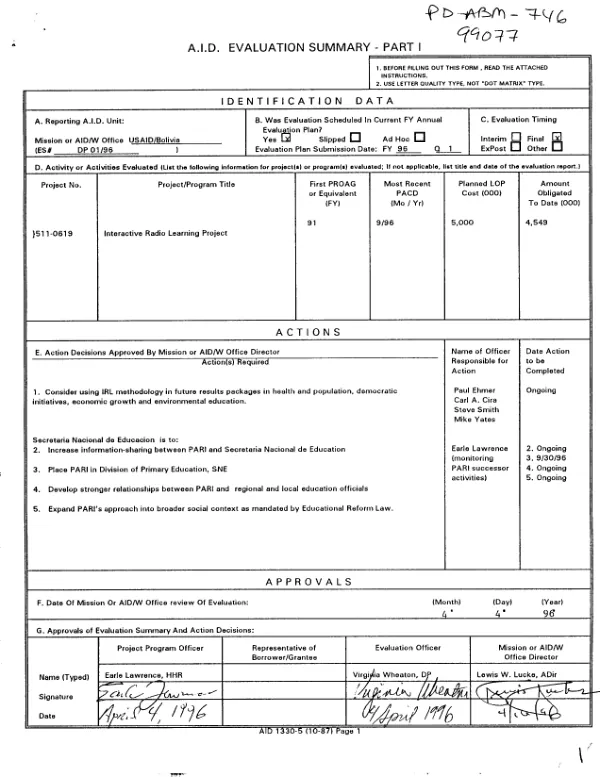
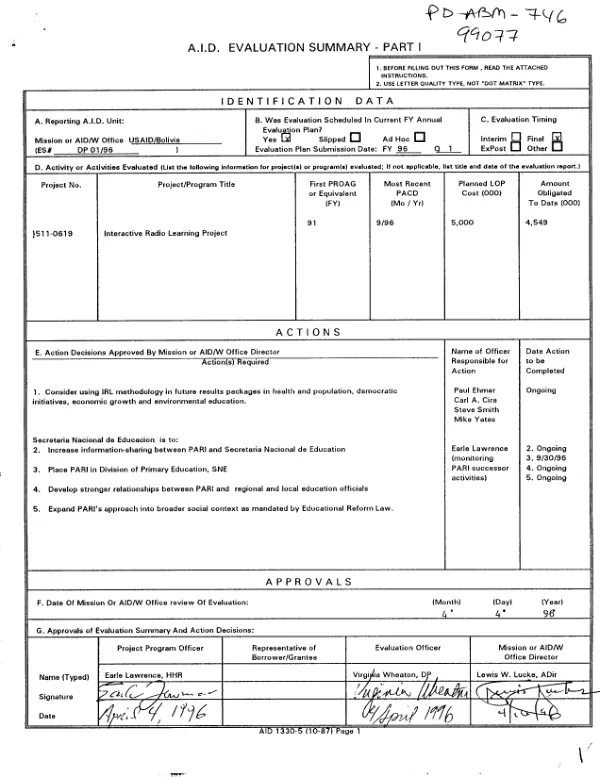
Summarizes final evaluation (XD-ABM-746-A) of a project to use interactive radio learning (IRL) to upgrade primary education in Bolivia (the PARI project -- Programa de Aprendizaje por Radio).
1996
Sign in to readA free account is required to download.
Abstract
Evaluation covers the period 1991-1995 against a 9/96 PACD. PARI has upgraded the quality of primary education and increased access to education in both mathematics (the curriculum was strengthened by PARI) and health (the curriculum was developed by PARI). PARI"s mathematics programs are used in more than 700 schools in all 9 departments of the country, serving more than 150,000 students in the 3rd, 4th, and 5th grades. Its health programs are used in 345 schools in 4 departments, serving more than 60,000 students in the same grades. PARI"s conceptual basis should be transferable to other countries if the teaching materials are suitably adapted. The project has a strong system of curriculum development, preparation, and production of radio programs and printed materials. PARI"s interactive methodology is generally well-received by school teachers and directors, and topics are well-developed and appropriate for specific grade levels. Lessons focus on preventive health, awareness of health and disease, and healthy behavior in daily life, and there is evidence that students apply the messages at home. However, timing of broadcasts is not always appropriate to children"s and teachers" needs, scheduling is not always reliable, and there are some technical problems with reception; a source of power is not always available in the schools. Teacher training needs considerable strengthening. While PARI has created high-quality teachers" guides and makes good use of child-to-child learning methods, the 1 day of training provided to teachers is insufficient. Most teachers lack an adequate conceptual framework for teaching health, and once the radio program has ended, must rely on their own understanding of the topics. The 25 teacher supervisors are also inadequately trained. To remedy this, PARI wrote a supervisors" training manual and has offered some training to senior level students in Bolivian Normal Schools, but more training is needed. Education Development Center (EDC), as contractor, has provided good TA in curriculum development, technical production, and program evaluation. However, when the EDC health educator was promoted to Chief-of-Party, the two positions were combined, and the project suffered. A distinct health education position is critical. Anticipating the assumption of PARI by the Secretariat of Education (SOE), the EDC directed a substantial part of its TA in the last 2 years toward project sustainability. However, the SOE, which has made PARI"s mathematics and health programs the official curricula for primary schools, is not yet capable of managing IRL and still depends almost entirely on PARI for curriculum and script development, all technical aspects of the program, and teacher training and supervision. PARI and the SOE need to strengthen their ties with regional and local health and education officials to create stakeholders in the program"s success. On the plus side, the Secretariat of Health is considering ways to collaborate with PARI in standardizing the school health education program. The Educational Radio Program (PER), the PVO established to implement the project, has provided invaluable services in curriculum design, materials" production, and teacher evaluation and training. PER should meet regularly with top SOE officials to discuss ways to implement educational reform. PER recently joined PROCOSI (an umbrella organization for health NGOs), which should expand its funding opportunities. Changes in attitude and professional direction may be difficult, but there is an openness to new structures and administration on the part of PER"s four principal members. From the outset, PARI has had a reasonably sophisticated system of evaluation. Data are extensively and meticulously collected, much of it indicating successful diffusion of the project. Analysis and interpretation are somewhat weak, however, making it difficult to judge program impact in rural vs. urban settings, gender differences, and long-term benefits. As for replication, IRL could be used in several USAID activities, most profitably in maternal and child health, reproductive health in the context of female literacy education, and democratization. The Mission notes that the attached evaluation was not revised in accordance with its wishes, lacks lessons learned, and only barely identifies PARI"s replicable successes.