USAID. BUR. FOR LATIN AMERICA. OFC. OF DEVELOPMENT PROGRAMS
Intercountry evaluation of education credit institutions in Latin America
The student loan movement in Latin America is growing steadily in size and influence.
Herrick, Allison B.|Sharlach, Howard R.|Seville, Linda · 1973
Sign in to readA free account is required to download.
Abstract
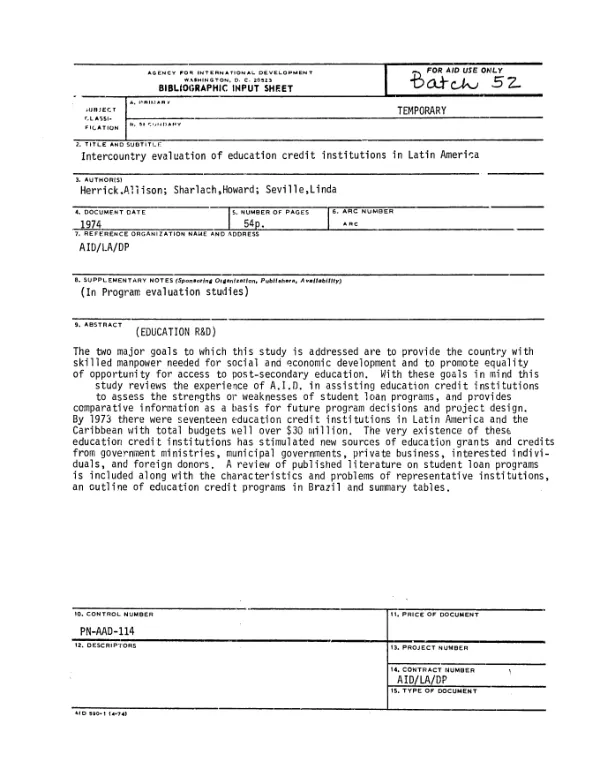
This study reviews A.I.D.'s experience in assisting education credit institutions to assess the strengths and weaknesses of student loan programs and provides comparative information as a basis for future program decisions and project design. In 1964, there were only four national credit institutions in Latin American and the Caribbean. By 1973, there were 17 such institutions (with total budgets well over $30 million), with plans for two more underway. The existence of these education credit institutions has stimulated a variety of new sources of education financing, including national government ministries, municipal governments, private businesses, interested individuals, and foreign donors, but has also helped to create acceptance for the idea that students should undertake greater financial responsibility for their own education. Moreover, these institutions appear to be financing a larger proportion of students in key fields than are represented in the general student body and making it possible for students to finish their training within a shorter period of time. Education credit institutions are most effective if they administer a wide range of programs and if they are involved as well in manpower planning, vocational and academic guidance, education-related research, job placement, and the development of imaginative proposals for further expansion of educational opportunities and financing. A review of published literature on student loan programs is included, along with a list of the characteristics and problems of representative institutions, an outline of education credit programs in Brazil, and summary tables.