USAID DEC
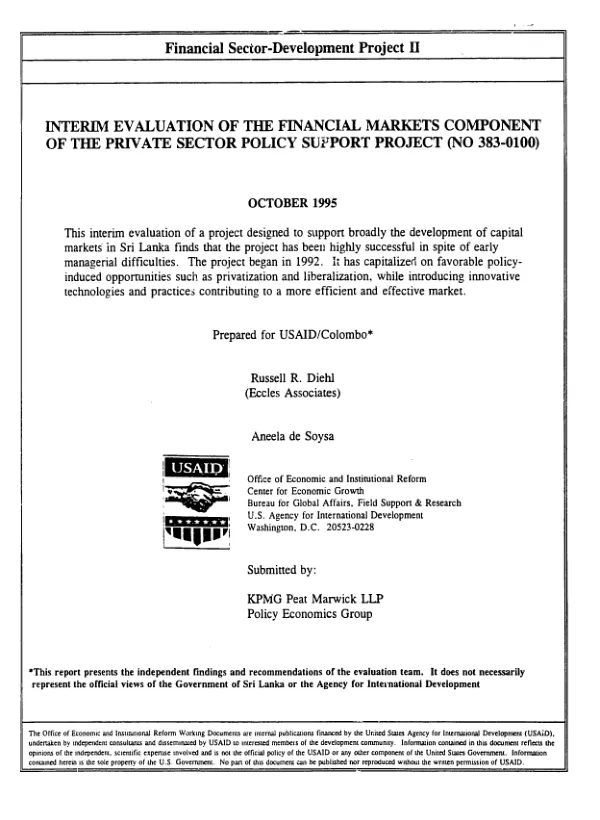
Interim evaluation of the financial markets component of the private sector policy support project (no. 383-0100)
Sign inKPMG PEAT MARWICK
Interim evaluation of the financial markets component of the private sector policy support project (no. 383-0100)
Interim evaluation of a project component to strengthen financial markets in Sri Lanka.
Diehl, Russell R.|Soysa, Aneela de|de Soysa, Aneela · 1995
Sign in to readA free account is required to download.
Abstract
Evaluation covers the period 5/92-10/95. The project has already completed a number of its objectives, and is on its way to realizing those that remain. The TA and training it has provided to emerging financial institutions have strengthened their technical and operational capabilities and have resulted in the introduction of a number of new instruments into the market. The activities supported by the project are likely to be continued and further developed by the institutional structures that have been put in place. One of the project's most successful aspects has been enhancement of the Post Trade Automation System at the Colombo Stock Exchange (CSE). USAID assistance has enabled the CSE to increase the efficiency and the integrity of clearing and settlement systems and to cope with the substantially increased volumes of trading experienced during the early part of 1994. In the course of developing a market for Quoted Debt Securities, the project has secured a policy consulting role at the Central Bank of Sri Lanka (CBSL) and has provided the CBSL with considerable technical and training assistance, including preparation of policy papers to modify the CBSL's secondary window and repurchase operations (CBSL is expected to implement the principal proposals in 8/95). The project also assisted the CBSL in a program to focus on the merits of diversifying the portfolio of Sri Lanka's national pension fund, the Employees' Provident Fund. With regard to Industry Training and Certification of Securities Markets Professionals, the project has conducted 34 seminar programs for over 850 participants, sponsored 14 study tours to foreign stock exchanges and regulatory institutions, and initiated the Chartered Financial Analysts (CFA) Program, which has enable 69 candidates to sit for the CFA Levels I-III examinations in June 1995. The Securities and Exchange Commission (SEC) of Sri Lanka and the CSE have pursued regulation and self-regulation activities. The primary condition precedent for the project, a cess (user tax) levied on share transactions in the secondary market, has provided a funding source to help ensure the SEC's sustainability. TA has been provided in several areas, including the consolidation of rules and regulations related to security markets. The project now needs to focus on strengthening the SEC's and CSE's surveillance function. Financial reporting standards have shown rapid development over the past 2 years. Lanka (ICASL) has developed a technical and research unit, which examines accounting and auditing standards, and which has helped the ICASL to develop standards in preparation for the demands likely to be imposed on it by the Accounting Standards Monitoring Board. The following are lessons learned. (1) USAID's support for capital markets development is fully consistent with its mandate to promote broad-based sustainable economic growth. (2) Effective regulatory institutions are critical to the success of emerging capital markets. (3) The introduction of the Central Depository System (CDS), which has led to scripless trading, has had a significant impact on Sri Lanka's capital market. (4) Emerging markets in developing countries compete among themselves and then on a regional basis rather than globally. (5) The development of an efficient government debt securities market is essential to developing a private debt securities market. (6) Privatization and capital markets development programs are synergistic in Sri Lanka. (7) Demand-driven, cost-shared assistance to emerging financial institutions is an effective TA mechanism. (8) A comprehensive financial training program, such as the CFA program, can be implemented long distance and be successful locally if closely managed and professionally implemented.
![Final report : interim evaluation of the financial institutions and expansion [FIRE] project](https://covers.devme.ai/gen/59378.webp)
![Final report : interim evaluation of the financial institutions and expansion [FIRE] project](https://covers.devme.ai/gen/6258.webp)