USAID. MISSION TO INDONESIA
Financial markets project
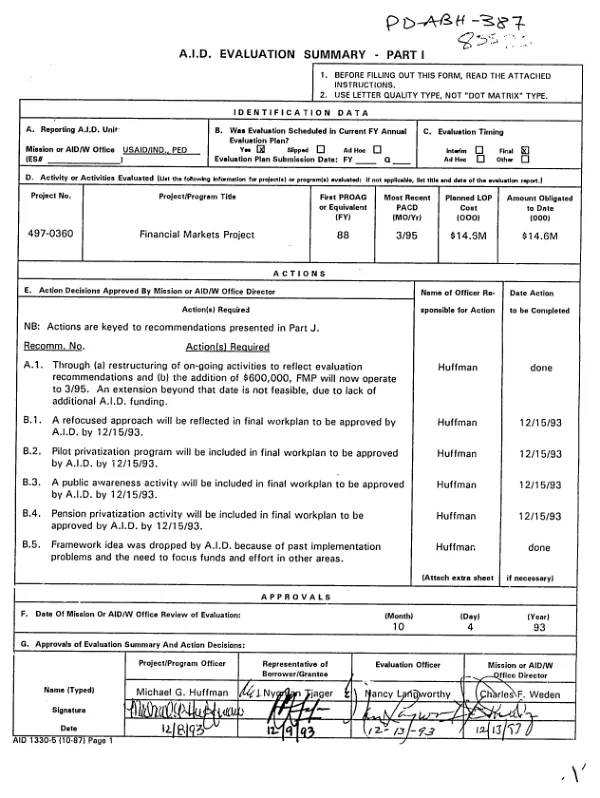
Summarizes mid-term evaluation (PD-ABG-958) of a project to enhance Indonesia"s financial markets and promote privatization of state-owned enterprises (SOEs).
1993
Sign in to readA free account is required to download.
Abstract
The evaluation covered the period 8/88-8/93. Start-up of the capital markets component was delayed 20 months. Monitoring and evaluation indicators specified in the Project Paper were not routinely tracked by either the contractor (Price Waterhouse) nor USAID. For work delivered, the contractor was reasonably efficient and effective at fulfilling the annual work plans, though assistance to the Jakarta Stock Exchange (BEJ) was not effective. A good working relationship exists with the Capital Market Executive Board (BAPEPAM), though assistance may have exceeded the agency"s absorptive capacity. Work on development of rules and stock exchange operations was excellent, and BAPEPAM is emerging as an effective regulatory force. It is unlikely, however, that all objectives of this component will be achieved by the PACD. BEJ activity has increased rapidly and steadily since 1987, but most of the expansion took place before the effects of the project materialized, although the project has likely aided market stabilization and growth since 1993. Because of the delay in start-up, the ongoing increase in capital market development, and the progress already achieved, the evaluation recommends extending the component through 12/96. Results of the privatization component have been disappointing. While SOEs have become more efficient, little actual privatization has occurred. Between 1987-1991, nine new SOEs were created, but only one has sold shares on the BEJ. There have been some successes, including completion of the first round of classification of SOEs into categories of assistance required, and development of a proposal for pension fund privatization, but many activities -- such as work on public awareness of privatization, and institutional strengthening of the Directorate General of SOEs (DG/SOE) -- have had to be put on hold due to apparent changes in the Government of Indonesia"s (GOI"s) commitment to and plans for privatization, and the ongoing reorganization of DG/SOE. Price Waterhouse has been responsive to requests for assistance, provided high-quality advice, and developed a constructive working relationship with the GOI. The money markets component also has failed to meet many of its objectives (e.g., development of new money market instruments, of a debt market, and of credit rating, check clearing, and electronic funds transfer systems) because the project got off to a late start, and did not fund short-term TA as planned. However, significant progress has been made toward developing a government bond market. While the long-term advisor from Deloitte and Touche has done a good job, without short-term TA his efforts are spread thin. In the training component, more than 150 programs have been carried out in responsive fashion, with emphasis shifting from in-country training to improve BAPEPAM staff to overseas training to improve overall understanding of how capital markets are managed. Training has included preparation of materials for local activities, institutionalization of capital market training in Indonesia, build-own-operate/build-own-transfer (BOO/BOT) workshops for government officials and support for attendance at international privatization seminars. However, the relevance of U.S. training -- which has comprised 80%-90% of all training -- to BAPEPAM officials" everyday work is questionable. The following lessons have been learned. (1) The absence of specified and timed deliverables impairs a project officer"s ability to detect difficulties or delays in implementation. (2) For assistance to be effective, there must be ongoing demand. "They need it, but do they really want it?" should be a key question. (3) When host-country management of the project and the political environment changes, it should be determined whether the new administration agrees with project objectives. (4) Sufficient funds must be available to meet project objectives. (5) Close monitoring by the contractor and USAID allows continual reassessment of emphases on areas and issues that are only marginally relevant to project objectives.
Related documents