USAID. MISSION TO HAITI
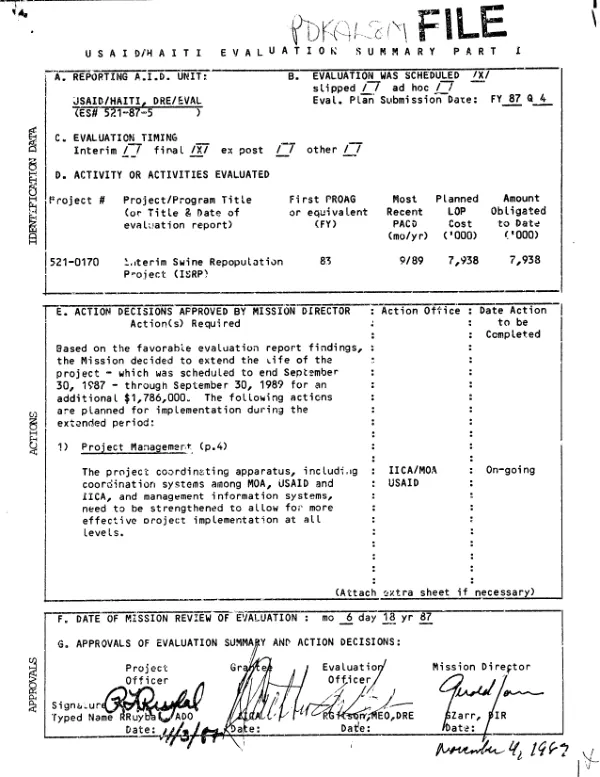
Interim swine repopulation project (ISRP)
Summarizes attached final evaluation of a project to produce and distribute improved swine breeding stock to Haitian peasant farmers whose herds were destroyed following an outbreak of African Swine Fever in 1979.
1987
Sign in to readA free account is required to download.
Abstract
Evaluation covered the period 1983-6/87 and was based on site visits and interviews with the managers of swine multiplication centers (SMC"s), beneficiaries, project personnel, and persons involved in the pig industry. The project, which has been well-managed by the Interamerican Institute for Cooperation in Agriculture (IICA), has proceeded well despite several infrastructural constraints. Some 440 SMC"s have been established (vs. 50-70 planned) and the distribution of pigs to SMC"s and farmers has exceeded also targets; repopulation is being achieved at a rapid rate and the pigs seem to be adapting well to local conditions. However, the pigs" rapid reproduction is placing pressure on the existing infrastructure of markets, extension, credit, veterinary services, and feed supply. In fact, feeding has been found to be the major constraint for expanding pig production as there is currently a lack of availability of the major feed source, wheat shorts extracted from imported wheat. Moreover, in several areas, limited water supply is an additional factor. An efficient extension network has been developed at both the SMC and farm level. However, training has not sufficiently focused on adapting farmers" management practices to local infrastructural constraints. The immediate challenge for the project (which is being extended 2 years in view of the favorable evaluation) is to develop a basically simple yet effective extension package, using the regional and local SMC network as the vehicle. The development of SMC"s has meant, in many cases, the establishment of groups mobilized to engage in community activities. In addition, the project should: fine-tune SMC management; and consider linkages with an upcoming Inter-American Development Bank project, especially in training and extension. The project"s lessons are two: (1) because of pigs" rapid reproduction rate, pig production projects must address infrastructure issues; (2) a limiting factor in livestock projects, especially in establishing a national animal health monitoring system, is lack of trained personnel - projects should train a sufficient number of people early on. USAID/H feels that while the evaluation report contains valuable information, it lacks overall integration and does not address the project"s contribution to the achievement of Mission strategy and sectoral objectives; also, the Development Impact section in the Executive Summary is somewhat superficial, and does not seem to be based on any substantive analysis elsewhere in the report.