USAID. MISSION TO ZIMBABWE
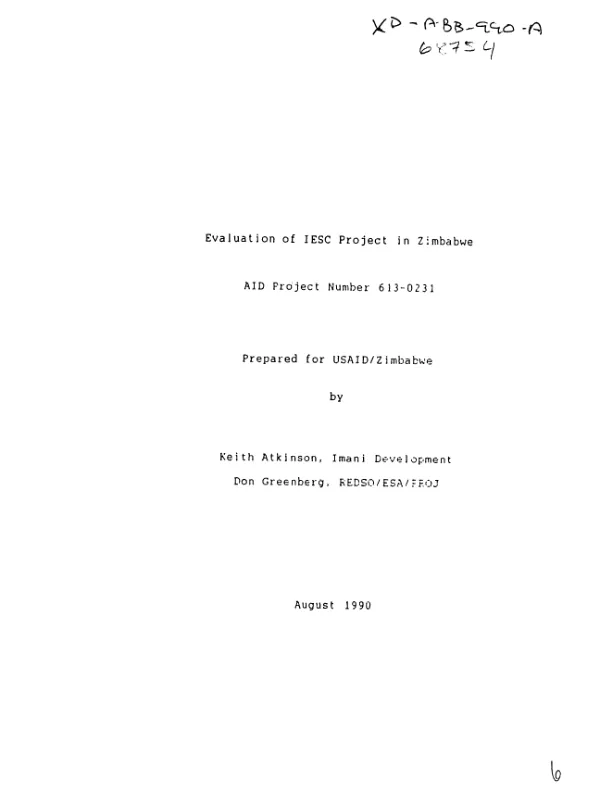
International Executive Services Corps : technical assistance to business
Summarizes final evaluation (XD-ABB-990-A) of a project to provide low-cost management expertise and technology transfer to Zimbabwean businesses.
1990
Sign in to readA free account is required to download.
Abstract
The International Executive Service Corps (IESC) is the implementing agency. Impact evaluation covered the period 9/85-9/90 and was based in part on beneficiary interviews and questionnaires. The project achieved its purpose by providing substantial assistance to recipients at a relatively high value-for-money. More than 90 volunteer executive projects were completed. IESC also carried out 11 American Business Linkage Enterprise projects, which provide in-depth information services giving clients access to technology sources, marketing opportunities, and funding availability. No joint venture projects were carried out. The majority of projects were undertaken in the private manufacturing sector across a broad spectrum of fields. Nearly all projects were with medium- to large-scale firms despite the intention to target more small companies in recent years. The volunteer executive program in increased employment by more than 1,000 workers, improved production practices, increased sales, and improved quality control among beneficiaries. Clients were generally satisfied with IESC services. Direct impact on export performance, however, was only limited. Three major lessons were learned. (1) IESC client selection is highly dependent on the motivation and orientation of the country director, who may have difficulties in relating to certain business sectors, particularly the less formal. (2) Funding constraints can create an inherent conflict in meeting objectives of targeting small business due to larger fees earned by IESC from bigger companies. (3) Quantitative analysis is difficult to achieve if too much time elapses between evaluations. Recommendations address the above-noted concerns.