INTERNATIONAL RICE RESEARCH INSTITUTE (IRRI)
International Rice Research Institute; annual report, 1971
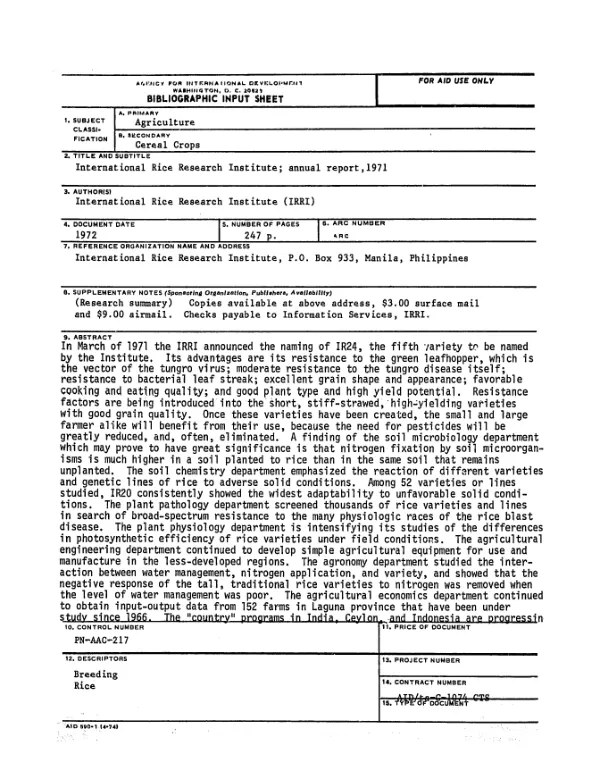
In March of 1971, the IRRI announced the naming of IR24, the fifth variety to be named by the Institute.
1970
Sign in to readA free account is required to download.
Abstract
Its advantages are its resistance to the green leafhopper, which is the vector of the tungro virus; moderate resistance to the tungro disease itself; resistance to bacterial leaf streak; excellent grain shape and appearance; favorable cooking and eating quality; and good plant type and high yield potential. Resistance factors are being introduced into the short, stiff-strawed, high-yielding varieties with good grain quality. Once these varieties have been created, the small and large farmer alike will benefit from their use, because the need for pesticides will be greatly reduced, and, often, eliminated. A finding of the soil microbiology department which may prove to have great significance is that nitrogen fixation by soil microorganisms is much higher in a soil planted to rice than in the same soil that remains unplanted. The soil chemistry department emphasized the reaction of different varieties and genetic lines of rice to adverse solid conditions. Among 52 varieties or lines studied, IR20 consistently showed the widest adaptability to unfavorable solid conditions. The plant pathology department screened thousands of rice varieties and lines in search of broad-spectrum resistance to the many physiologic races of the rice blast disease. The plant physiology department is intensifying its studies of the differences in photosynthetic efficiency of rice varieties under field conditions. The agricultural engineering department continued to develop simple agricultural equipment for use and manufacture in the less-developed regions. The agronomy department studied the interaction between water management, nitrogen application, and variety, and showed that the negative response of the tall, traditional rice varieties of nitrogen was removed when the level of water management was poor. The agricultural economics department continued to obtain input-output data from 152 farms in Laguna province that have been under study since 1966. The "country" programs in India, Ceylon, and Indonesia are progressing well.