INTERNATIONAL RICE RESEARCH INSTITUTE (IRRI)
International Rice Research Institute; annual report, 1972
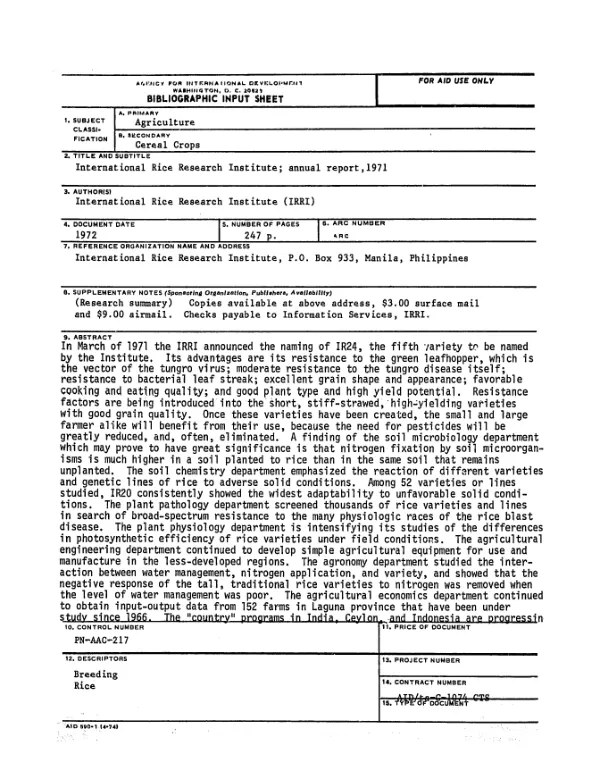
The limited acceptance of IR22 and IR24, which possess a high yield potential and excellent grain quality, demonstrated once again that disease and insect resistance is an indispensable characteristic which must be incorporated in new varieties to ensure their widespread dissemination.
1970
Sign in to readA free account is required to download.
Abstract
IR20, which has somewhat lower yield potential but a broad spectrum of disease resistance, rapidly spread to many new areas, including the Philippines, South Vietnam, and Bangladesh, where it is now the most popular variety. IR20 has also begun to make an impact in Ceylon and India. However, the most important accomplishments of the Institute are the introduction of improved genetic materials into national research programs, the development of communication networks among rice scientists, the training of scientific staff, and the upgrading of research and extension programs in many countries. In 1972 alone, more than 10,000 seed samples of the Institute"s breeding lines and varietal collection were supplied to 69 countries. Many genetic lines developed at IRRI but not named by the Institute were released as varieties in other countries. In spite of the high yield potential of new varieties, only about 15 percent of the rice land in South and Southeast Asia is planted to high-yielding varieties developed at IRRI and by national programs. Susceptability to diseases and insects is a strong constraint to further extension of the new technology. The IRRI crossing program was greatly expanded in 1972 to combine diverse sources of resistance to major diseases and insects. A total of 1,000 crosses was made during the year. Selections with improved plant type and excellent grain quality, which combine resistance to blast, bacterial leaf blight, tungro virus, grassy stunt virus, brown planthopper, and green leafhopper, are now available. The applied research project on rainfed lowland and upland rice farms started in Central Luzon in 1971 furnished valuable information. The results confirmed that yields of 4 t/ha can be obtained under rainfed conditions by using an improved package of practices which includes new high-yielding varieties, adequate fertilization, and insect and weed control. The plant pathologists and entomologists continued to develop improved sources of multiple resistance to insects and diseases and to improve screening techniques for use in breeding programs. Detailed investigations on sheath blight, a disease which is becoming increasingly important in Indonesia, Sri Lanka, Vietnam, and several other countries, showed that a high level of varietal resistance to the disease is available but the reaction is infuenced by environmental factors and age of the plant. A major advance in the chemical control of insects was the development of the concept of placing insecticides about 3 cm below the soil surface near the roots of transplanted seedlings.
Related documents