USAID DEC
Investing in Sustainable Energy Technologies in the Agrifood Sector (INVESTA) - Kenya's Vegetable Value Chain
Sign inFOOD AND AGRICULTURAL ORGANIZATION
Investing in Sustainable Energy Technologies in the Agrifood Sector (INVESTA) - Kenya's Vegetable Value Chain
The Kenyan vegetable sector is a growing market, with horticulture being the third leading agricultural subsector after dairy and tea.
2018 · 2 pages
Sign in to readA free account is required to download.
Abstract
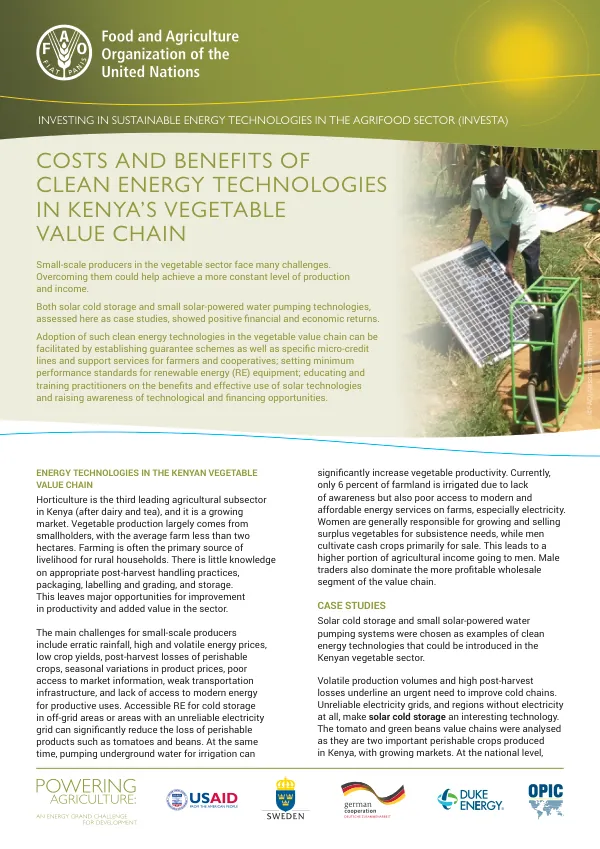
Vegetable production largely comes from smallholders, with the average farm less than two hectares. Farming is often the primary source of livelihood for rural households, and there is a lack of knowledge on appropriate post-harvest handling practices, packaging, labelling, and grading, and storage. This leaves major opportunities for improvement in productivity and added value in the sector. The main challenges for small-scale producers include erratic rainfall, high and volatile energy prices, low crop yields, post-harvest losses of perishable crops, seasonal variations in product prices, poor access to market information, weak transportation infrastructure, and lack of access to modern energy for productive uses. Accessible renewable energy (RE) for cold storage in off-grid areas or areas with an unreliable electricity grid can significantly reduce the loss of perishable products such as tomatoes and beans. At the same time, pumping underground water for irrigation can significantly increase vegetable productivity. Currently, only 6 percent of farmland is irrigated due to lack of awareness but also poor access to modern and affordable energy services on farms, especially electricity. Solar cold storage and small solar-powered water pumping systems were chosen as examples of clean energy technologies that could be introduced in the Kenyan vegetable sector. Volatile production volumes and high post-harvest losses underline an urgent need to improve cold chains. Unreliable electricity grids, and regions without electricity at all, make solar cold storage an interesting technology. The tomato and green beans value chains were analysed as they are two important perishable crops produced in Kenya, with growing markets. At the national level, there is potential for about 112 grid-connected solar cold storage systems (35 m3 capacity) for tomatoes and green beans that could be installed to serve farmer groups or associations at collection points. Both solar cold storage and small solar-powered water pumping technologies show positive financial returns and valuable co-benefits. Solar cold storage creates added value in the vegetable sector by reducing food losses. If coupled with improved information between market demand and available supply, cold storage can reduce product loss and congestion in the market place, as well as provide a tool to deal with market price volatility. Solar-powered pumps show good financial returns, reduce greenhouse gas emissions, improve access to energy, avoid fuel purchases, reduce time needed to supervise irrigation operations, and create employment (including technical support services). If early adopters were already irrigating their fields using traditional pumping systems, solar pumping does not bring an improvement in yields. Conversely, the co-benefits are significant if the solar-powered water pumping is adopted by farmers who rely on rainfed agriculture, but in this case the differential investment cost is higher. Policy measures, financial instruments, knowledge providers, and education schemes can facilitate the adoption of clean energy technologies in the Kenyan vegetable value chain. Policy-makers, private companies, and financial actors might support guarantee schemes and develop specific micro-credit lines coupled with support services for farmers and cooperatives wanting to adopt the clean energy technology, including instruments that hedge against production risk. They might also complement the effort for eradication of low efficiency and low quality equipment, usually imported and sometimes counterfeit, by setting minimum performance standards. Additionally, they might clarify the rules for import tax exemption of renewable energy equipment, educate practitioners about the benefits and effective use of the technology, provide training to farmers on the financial benefits of clean technologies, raise awareness of financing opportunities, train retailers to complement their offer with support services, and organize knowledge sharing events on e-commerce and real-time information systems.