USAID. BUR. FOR POLICY AND PROGRAM COORDINATION. CENTER FOR DEVELOPMENT INFORMATION AND EVALUATION (CDIE)
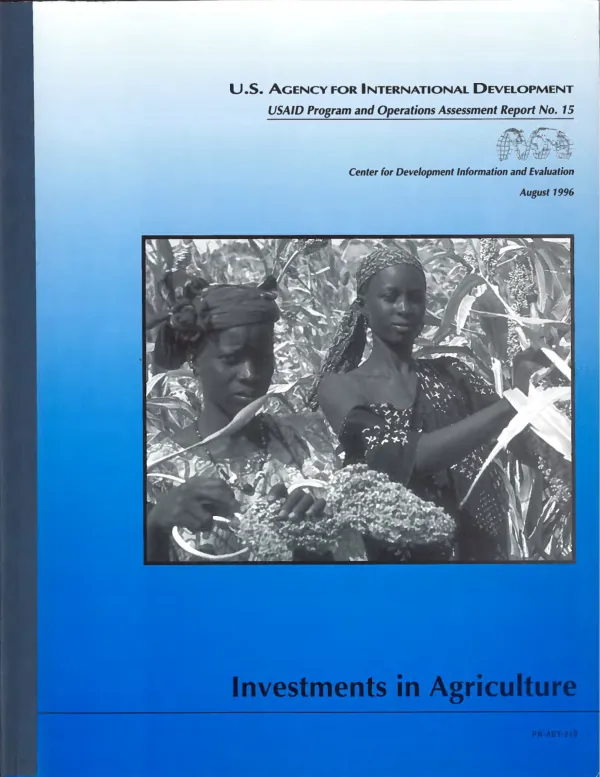
Investments in agriculture : a synthesis of the evaluation literature
USAID has invested substantial resources in agricultural development for the past 30 years (and more), with yearly investments in the 1980s exceeding $1 billion six times.
McClelland, Donald G. · 1996
Sign in to readA free account is required to download.
Abstract
This study synthesizes the findings of five background studies which assessed USAID's agricultural investments in the areas of, respectively: policy reform and planning, technology development and diffusion, rural infrastructure, services (especially credit), and asset distribution and access (especially land tenure security). The study concludes that agricultural development relies primarily on the market and on private sector investment, while also requiring that the public sector provide an enabling policy environment and essential "public goods." Specific findings are as follows. (1) The first priority is to develop an enabling environment, i.e., policies, technology, and infrastructure -- and of these three, policies are the most important. (2) It is inconclusive as to whether investments in all five agricultural subsectors are essential. Of greater importance is a country's predisposition to agricultural development -- regardless of donor investments. (3) Investments have been most successful when they have removed a bottleneck (e.g., agricultural research is more likely to prosper where infrastructure has been modernized) or when existing conditions have favored progressive change (e.g., policy reform efforts are more successful when they support an indigenous program of policy change than when donors try to introduce new policies. (4) Investments in agricultural technology development and diffusion generate high economic returns; the social benefits of such investments justify the costs under a wide variety of situations. (5) Government should become involved in an investment only if public sector involvement will raise real national income more than would otherwise be the case. (6) For the most part, the literature is silent on the question of which agencies (e.g., contractors, land grant universities) are best suited to implement which agricultural activities. (7) There is no empirical evidence that the United States enjoys a comparative advantage over other donors in providing assistance in technology development, although it may have an advantage in providing assistance related to policy reform and planning. Two major management recommendations are made. First, in countries with an adverse economic policy environment, USAID should invest reluctantly, if at all. Second, USAID should concentrate its investments on relieving binding constraints (not all constraints) to agricultural growth. Includes bibliography.