USAID DEC
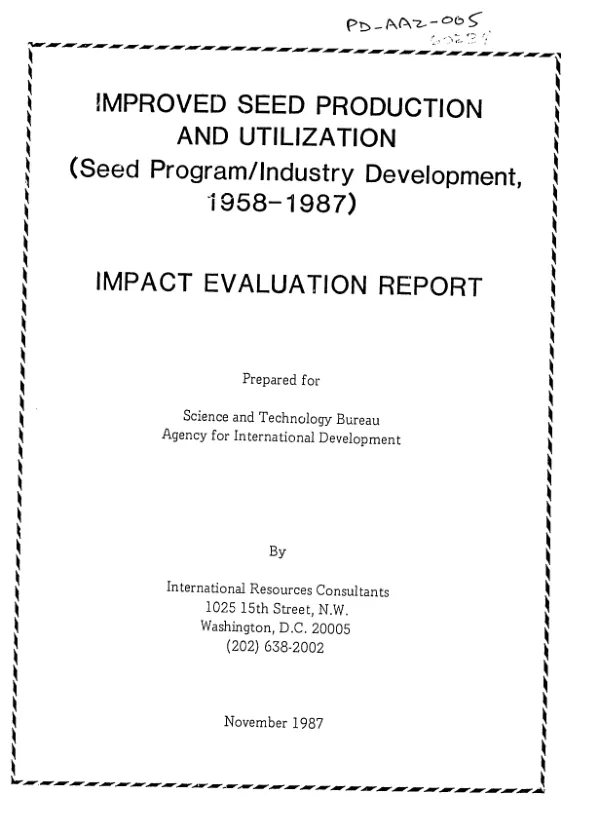
Impact evaluation of seed program and industry development and improved seed production and utilization projects
Sign inINTERNATIONAL RESOURCES CONSULTANTS, INC.
Impact evaluation of seed program and industry development and improved seed production and utilization projects
Mississippi State University (MSU) entered into a contract with the International Cooperation Administration, A.I.D.'s predecessor agency, in 1958 to provide TA on a worldwide basis in seed production, processing, storage, and distribution.
Fountain, Bertram R.|Hogan, Edward B. · 1987
Sign in to readA free account is required to download.
Abstract
Since then, there have been only 2 major changes: (1) in 1984, Missions were required to fund activities in their countries through buy-ins; (2) in 1986, emphasis was put on research and research networking rather than TA, service, training, and technology transfer. MSU has provided services under the centrally funded contract to 57 countries, as well as significant amounts of assistance financed by Missions or other donors. MSU's assistance has been clearly beneficial. Training has been particularly impressive, but achievements in other areas are also substantial. A functioning seed industry has been established in 4 countries, though the future viability of the seed industry in Niger is much less clear than in Honduras, Brazil, and Thailand. In each of the last 3 countries, an effective, profitable, and growing private seed industry has been established. Establishment of a viable industry was more readily achieved when there was also bilateral assistance in seed technology. Training has strongly influenced the initiation of seed programs in developing countries. In countries such as Brazil and Thailand and at CIAT, training on a regional and country basis is now conducted by people trained by MSU. While research was not a major focus, the necessity for MSU to seek solutions to technological problems led to research which has made a substantial contribution to drying and storing seed in the humid tropics. MSU has been committed to fostering private enterprise involvement in the seed industry in the U.S. and overseas. A characteristic of seed programs where MSU was involved is the development of a private seed industry when profile opportunities come into being. In comparison to services provided by similar institutions, MSU's cost of providing services has been low and greater amounts of total funding have been allocated to providing TA. This TA has been of very high quality, as is recognized by private enterprise, other research organizations, LDC's, and the donor community. Lessons Learned and Policy Implications: (1) Seed programs need to consider the roles of both private enterprise and public service. (2) An ongoing agricultural research program dedicated to providing improved crop varieties is necessary for project success. (3) Continuity and integration into ongoing programs significantly improves the quality of services provided to A.I.D. by outside organizations and so does the use of permanent tenured staff. (4) Wide support by government is helpful to the establishment of a viable seed program. (5) International centers can be excellent locations for regional training. (6) Follow-on activities after project completion can be important to successful institutionalization of programs. (7) The buy-in system of financing has led to some delays and inefficiencies. (Author abstract)