USAID
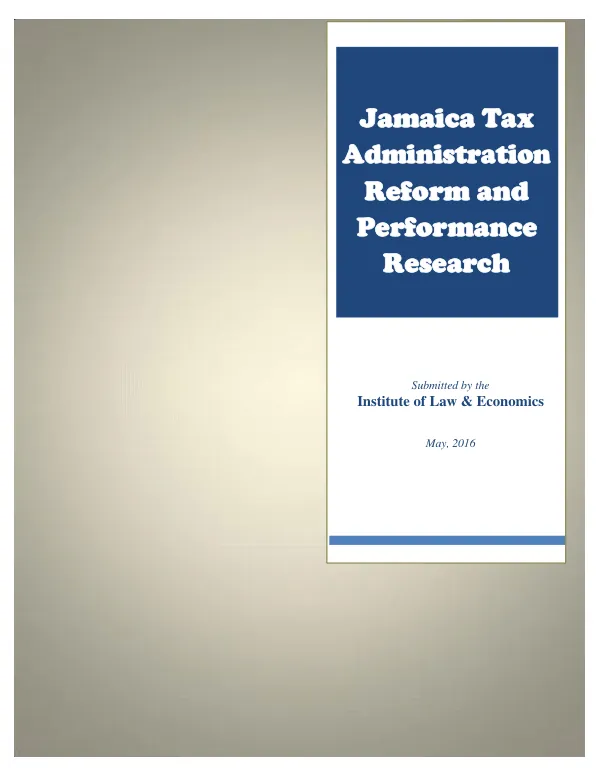
Jamaica Tax Administration Reform and Performance Research
Jamaica's tax system was introduced in 1664 by the English Governor, Sir Thomas Modyford.
2016 · 48 pages
Sign in to readA free account is required to download.
Abstract
Income Tax was introduced in Jamaica at the end of World War I by the Income Tax Act of 1919 and came into operation in 1920. The 1919 Income Tax Act provided for tax to be charged for 1920 on the income of 1919 and thereafter for each subsequent year on the income of the preceding year. It also required a return of income to be rendered by every person liable to pay tax and established an Assessment Committee to assess the tax. The original Act provided for the appointment of persons to assist taxpayers in completing their income tax returns and the appointment of Collectors of Taxes as the first assistors. The method of determining a person's tax liability by reference to the income of the preceding year remained the same up to 31st December, 1952. Two major changes were introduced after this date. The Income Tax (Employment) Act of 1952 paved the way for the introduction of a Pay-As-You-Earn (PAYE) System from the 1st of January 1953. Employees then became liable to pay tax on their wages and salaries as they were earned. Other sources of income remained taxed on the income of the preceding year. The Income Tax Law was consolidated into one Act - Act 59 of 1954 (hereafter called the "ITA"). The ITA provided that all income, profits, and gains were to be taxed on the actual income of the year of assessment - that is, the year to 31st December. The ITA also brought into effect "self-assessment", which was based on the concept of the taxpayer's voluntary compliance with the Income Tax Law. Under this system, the taxpayer pays during the year of assessment and by the 15th March in the following year, he/she makes a return of income accompanied by a statement of his/her actual tax liability showing the amount, if any, of the tax that remained unpaid. This research seeks to highlight the progress that Tax Administration Jamaica (TAJ) has made in implementing policies and infrastructure to achieve improved compliance among taxpayers. The study focuses mainly on Income Tax compliance, however General Consumption Tax (GCT) and other tax types are mentioned where necessary. The research aims to provide Jamaican policymakers with specific trends in filing and payment compliance and recommendations to improve filing and payment compliance of businesses in Jamaica. With knowledge of the trends in tax compliance and the key reasons for tax non-compliance, policymakers' attention will be directed towards taking steps to alleviate the problem. The study has identified various factors that impact tax compliance behavior, including the characteristics of non-compliant taxpayers. The Government of Jamaica should consider seriously the characteristics of non-compliant taxpayers, review current regulations, and possibly increase audit rates and penalty rates (enforcement) as well as attempting to build good relationships with taxpayers. The study also highlights the importance of filing and payment compliance, particularly when the government faces poor fiscal conditions such as serious fiscal deficits and global economic recessions.
Related documents