USAID DEC
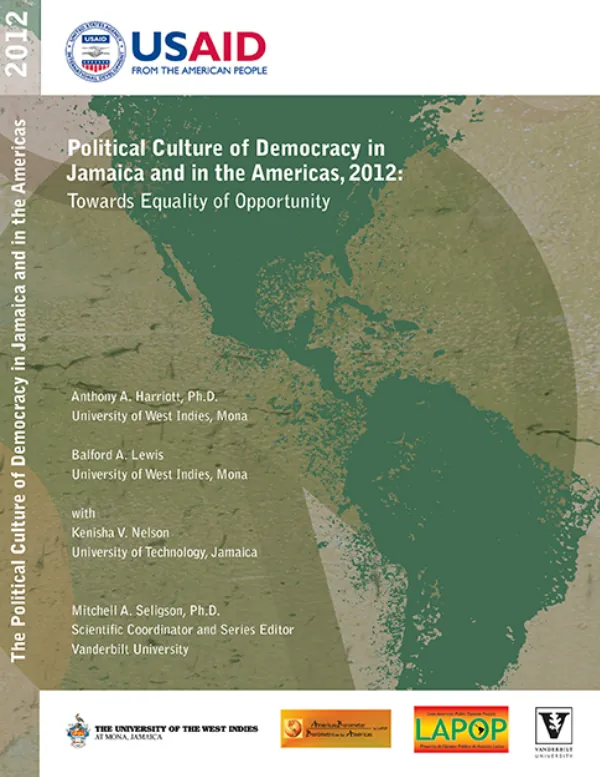
The Political Culture of Democracy in Jamaica and in the Americas, 2012: Towards Equality of Opportunity
Sign inLAPOP – VANDERBILT UNIVERSITY
The Political Culture of Democracy in Jamaica and in the Americas, 2012: Towards Equality of Opportunity
The study "The Political Culture of Democracy in Jamaica and in the Americas, 2012: Towards Equality of Opportunity" was conducted by a team of researchers led by Professor Anthony A.
2013 · 302 pages
Sign in to readA free account is required to download.
Abstract
Harriott, PhD, and Balford A. Lewis, with Kenisha V. Nelson and Mitchell A. Seligson, PhD, serving as co-authors. The study was supported by the Program in Democracy and Governance of the United States Agency for International Development. The research focused on the political culture of democracy in Jamaica and the Americas, with a particular emphasis on equality of opportunity. The study aimed to investigate the extent to which citizens in Jamaica and the Americas perceive equality of opportunity and democracy, and to examine the relationship between these perceptions and various policy proposals. The study employed a survey-based approach, using data from the AmericasBarometer, a regional public opinion survey conducted in 2012. The survey collected data on a range of topics, including economic and social opportunities, political participation, and perceptions of corruption and crime. The study found that citizens in Jamaica and the Americas generally support the idea of equality of opportunity, but that there are significant disparities in the extent to which different groups perceive themselves as having equal opportunities. For example, the study found that women and marginalized racial/ethnic groups tend to perceive themselves as having fewer opportunities than men and non-marginalized groups. The study also found that public opinion on policy proposals aimed at promoting equality of opportunity is generally supportive, but that there are significant differences in the extent to which different groups support these proposals. For example, the study found that women and marginalized racial/ethnic groups tend to be more supportive of policies aimed at promoting women's leadership and reducing economic and social inequality. In terms of political participation, the study found that citizens in Jamaica and the Americas generally have low levels of participation, particularly among marginalized groups. The study also found that public opinion on opportunities and discriminatory attitudes is generally negative, with many citizens expressing concerns about the lack of opportunities and the prevalence of discriminatory attitudes. The study concluded that promoting equality of opportunity and democracy in Jamaica and the Americas will require addressing the significant disparities in opportunities and perceptions of opportunities that exist among different groups. The study recommended a range of policy proposals aimed at promoting equality of opportunity, including increasing access to education and economic opportunities, promoting women's leadership, and reducing economic and social inequality. The study also found that corruption and crime are significant concerns for citizens in Jamaica and the Americas, with many citizens expressing concerns about the prevalence of corruption and crime. The study found that perceptions of corruption and crime are closely related to perceptions of insecurity and crime victimization, and that these perceptions have a significant impact on support for the political system. Overall, the study provides a comprehensive analysis of the political culture of democracy in Jamaica and the Americas, and highlights the significant challenges that exist in promoting equality of opportunity and democracy in these countries.