USAID DEC
Joint evaluation of the grant between US Agency for International Development and African - American Labor Center
Sign inAFRICAN-AMERICAN LABOR CENTER (AALC)
Joint evaluation of the grant between US Agency for International Development and African - American Labor Center
Interim evaluation of a grant to the African-American Labor Center (AALC) to expand its efforts to develop self-sufficient democratic trade unions in sub-Saharan African countries (exclusive of South Africa).
Roush, James L.|Barrett, Jerome|Iskander, Kate · 1994
Sign in to readA free account is required to download.
Abstract
The evaluation covers the period 9/91-7/94. This has been a particularly important time for USAID to be supporting sub-Saharan African trade unions. The unions have deserved support because of their efforts on behalf of democracy, and they have needed it both because of government retaliation (in some countries) for these efforts, and because of the fall-out from economic restructuring. Increasing efforts to scale back civil service employment and restructure or privatize government enterprises have hit union membership, influence, and financing particularly hard, since civil servants' and public employees' unions have historically been the core of unionism in African countries. Economic and political turmoil have also strained government-industry-trade union relations. The tripartite committee system and the industrial courts, both designed to deal with industrial relations, are not performing well; additional institutions and/or processes are needed to reduce the level of labor-management conflict. USAID objectives in sub-Saharan Africa during this critical period have been well served by the grant to AALC. Although the political situation has at times precluded AALC activity, where it could operate AALC has responded effectively to trade union needs. It has increased the number of its country programs from 23 in 1991 to 29 in 1993, with over 70% of the direct costs of the grant going to country programs, i.e., to support individual trade union centers. The grant also funds rapid assistance to trade union federations; initial activities where a full-scale program is not yet called for; activities by U.S. unions with counterpart African unions under the auspices of International Trade Secretariats; and collaborative activities with regional and sub-regional trade union organizations. Due in significant measure to AALC support, trade union leaders appear to understand and accept the need for economic restructuring, even though they think that the process could be carried out more humanely and with trade union participation. Given the increasing number of countries eligible for participation in the program, the speed of political developments in the region, and the fact that AALC is already stretched thin, especially in terms of field representation, it is recommended that AALC expand its activities and infrastructure. Among the specific recommendations are for AALC to: (1) increase its monitoring capability in the field, hiring additional local staff and specialists, and establishing an additional regional office (possibly two when the turmoil in a number of countries ceases); (2) undertake more research for, and information sharing with, trade union federations on such subjects as institution building, conflict resolution, project development, and comparative labor codes; and (3) increase contacts with other donors, USAID Missions, trade union representatives, etc. It is also recommended that A.I.D. fund a resumption of the Department of Labor's tripartite visitors program, which brought representatives of Ministries of Labor, employer associations, and labor unions together in the United States.
Related documents
Documents in this collection
 1989
1989USAID DEC
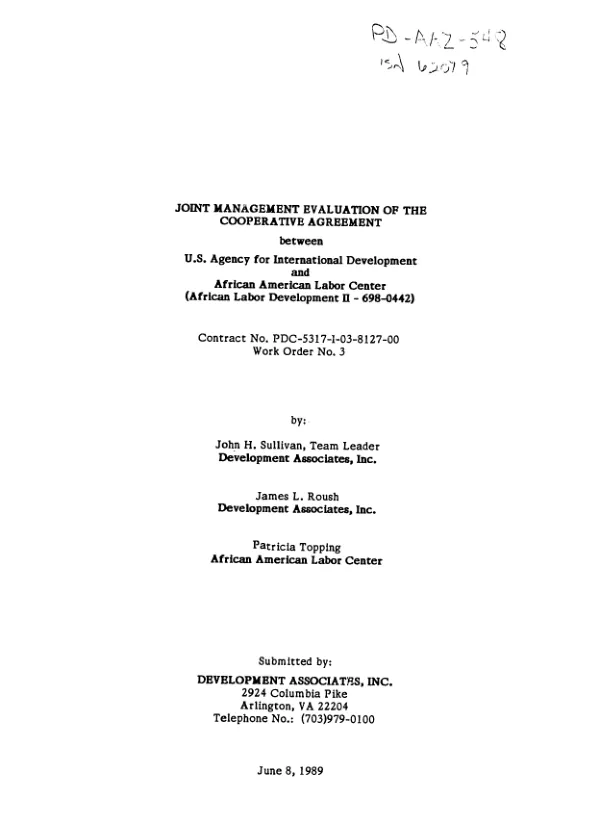
Joint management evaluation of the cooperative agreement between US Agency for International Development and African American Labor Center (African labor development II, 698-0442)
Open record 1997
1997USAID DEC