USAID. BUR. FOR NEAR EAST. REGIONAL HOUSING AND URBAN DEVELOPMENT OFC.
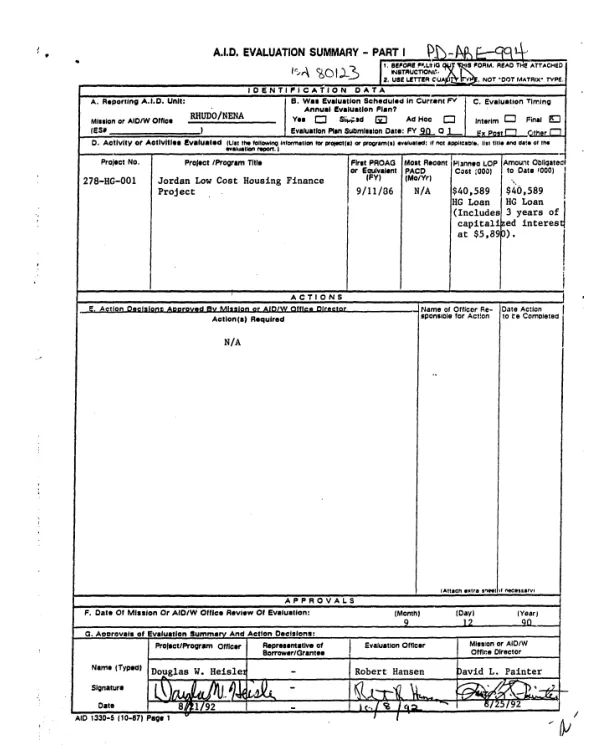
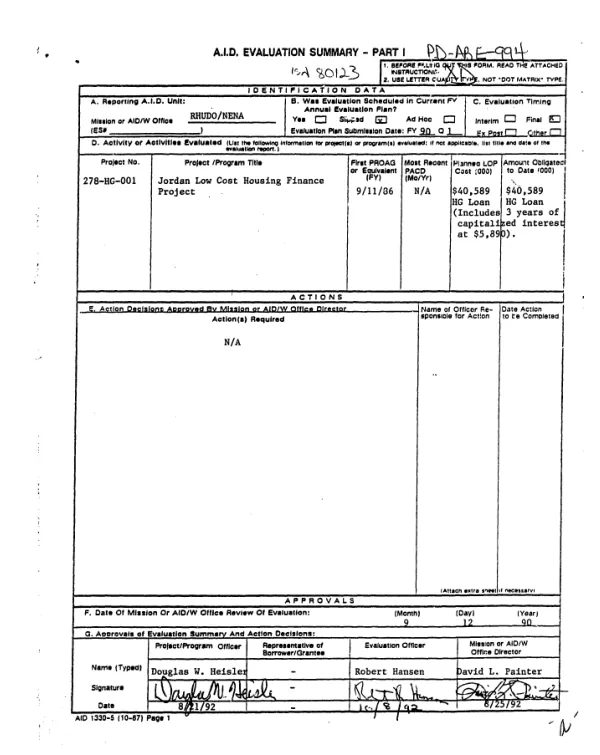
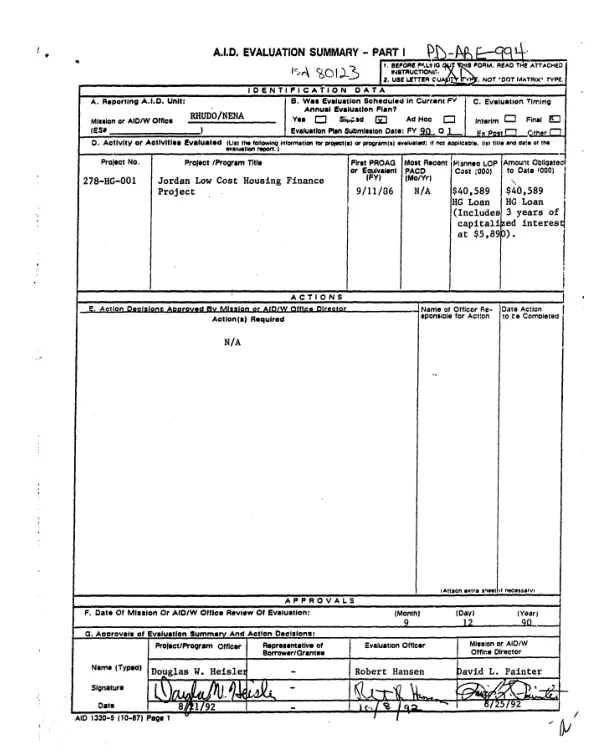
Jordan low cost housing finance project
Summarizes final evaluation (XD-ABE-994-A) of a Housing Guaranty (HG) program, initiated in 9/86, to increase the availability of low-income housing in Jordan through: (1) an Individual Loan Program (ILP), to increase the Jordan Housing Bank"s (JHB) provision of mortgage credit to below median income families; and (2) an experimental Private Developer Program (PDP), administered by the JHB and aimed at increasing private sector production of low-income housing.
1992
Sign in to readA free account is required to download.
Abstract
The evaluation was conducted in 8/90, but final minor revisions were delayed until 8/92 due to the Gulf War. The ILP was extremely successful; 4,739 loans with a combined value of JD 16,938,365 were made, and a broad range of beneficiaries were served, both in Greater Amman and in other urban areas; over 40% of beneficiaries were at or below the 20th income percentile. The average loan amount was under JD 4,000 and the average term less than 10 years. The JHB successfully sustained the cost of administering the ILP for low-income beneficiaries, for whom loans were made at 8% interest, necessitating cross-subsidies. However, the volume of lending under the ILP continued to decline over the life of the program. The PDP did not achieve its target of 700 loans for reasons beyond the program"s control. Economic decline caused two devaluations of the dinar; this affected construction costs and made private developers more dependent on purchasers with foreign currency. As market uncertainty increased even further, private developers became more hesitant to take risks on the type of units that could be built at a price affordable to low-income purchasers. Subdivision regulations and high property transfer taxes made it impossible to build an affordable unit which met the desires of the target group. Furthermore, in 1987 the Jordan Housing Corporation, a government housing institution, flooded the low-income market with 3,500 housing units priced at terms against which private developers could not compete. The following lessons were learned. (1) Sector policy and regulations were the two largest constraints to owner/builder and private developer production of low-cost housing. A new HG (HG-004) will focus more on these issues. (2) The program"s assessment of the potential roles of private developers in meeting the low-income population"s housing needs was overly optimistic. HG-004 should focus on improving access to land for owner/builders, and on assessing and defining the roles of owner/builders, private developers, and government housing institutions.