USAID DEC
Judicial Code of Conduct Workshop Report
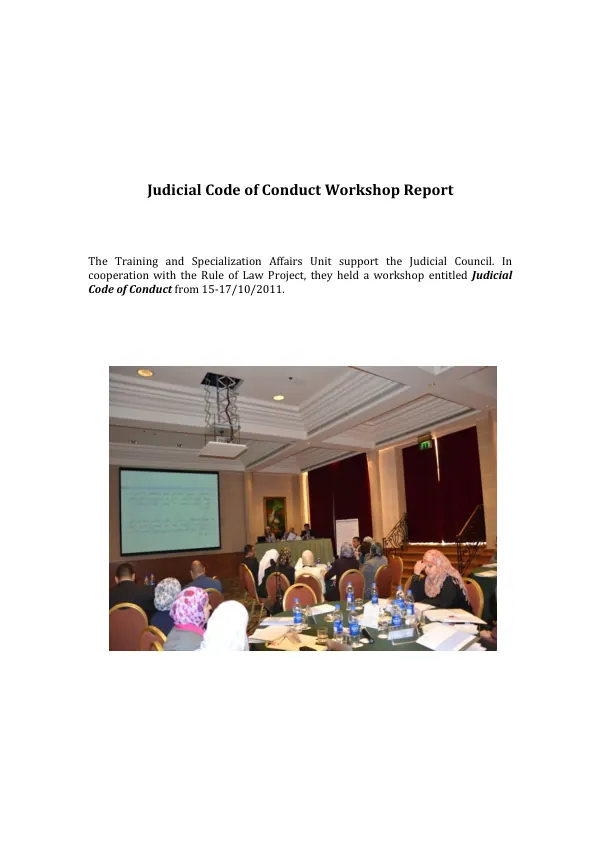
The Judicial Code of Conduct Workshop was held from 15-17 October 2011, with the support of the Training and Specialization Affairs Unit and in cooperation with the Rule of Law Project.
2011 · 12 pages
Sign in to readA free account is required to download.
Abstract
The workshop aimed to advance the performance of judges inside the courtroom and instill rules of conduct with the general public and lawyers. A total of 73 newly-appointed judges attended the workshop, which was facilitated by a cassation court judge assigned by the Chief Justice. The workshop agenda was divided into three parts, focusing on the Judicial Code of Conduct: independence of the judiciary and trial guarantees, judicial conduct and the relation of the judge with lawyers, and competence and capabilities. Each day, three attendees were assigned the task of preparing introductory paragraphs, which were then presented to the group and followed by extensive discussions and debates. The session facilitator and the director of the Training and Specialization Affairs Unit managed the discussions and summarized the final recommendations. The workshop was attended by two groups of judges, with the first group consisting of 37 judges and the second group consisting of 36 judges, along with H.E. cassation judge Mohammad Al Humsi and Dr. Nashat Al Akhras, the judge heading the Training and Specialization Affairs Unit. The attendees were split into two groups, with each group attending different presentations and discussion sessions on the three topics. The presentations and discussion sessions were facilitated by a number of judges participating in the workshop, who prepared introductory presentations for each topic. The sessions were extensive and included debates, facilitated and managed by the session facilitator and the director of the Training and Specialization Affairs Unit. A questionnaire was used as a tool to measure the knowledge and attitudes of trainees across two pillars: evaluation of the workshop and evaluation of the course. The questionnaire covered 8 questions that included implementation methodology of the course, the level of achievement of workshop objectives, and the overall satisfaction of the attendees. The workshop aimed to achieve several objectives, including advancing the performance of judges inside the courtroom and instilling rules of conduct with the general public and lawyers. The workshop also aimed to introduce a new training methodology, which relied on interactive discussions and debates, rather than traditional training delivery techniques. The workshop was a success, with attendees showing a high level of satisfaction and engagement throughout the sessions. The workshop's evaluation revealed that the attendees showed a high level of knowledge and understanding of the topics presented, with many attendees expressing a desire for further training and development. The workshop's recommendations and suggestions included the need for continuous training and development for judges, as well as the need for a more interactive and engaging training methodology. Overall, the Judicial Code of Conduct Workshop was a successful event that aimed to advance the performance of judges inside the courtroom and instill rules of conduct with the general public and lawyers. The workshop's evaluation revealed a high level of satisfaction and engagement among attendees, and the recommendations and suggestions provided a clear direction for future training and development initiatives.