USAID. MISSION TO EL SALVADOR
Judicial reform
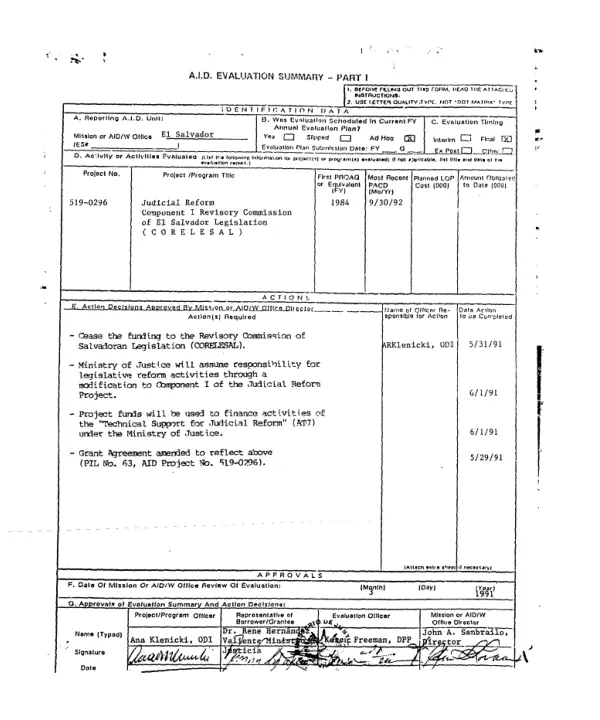
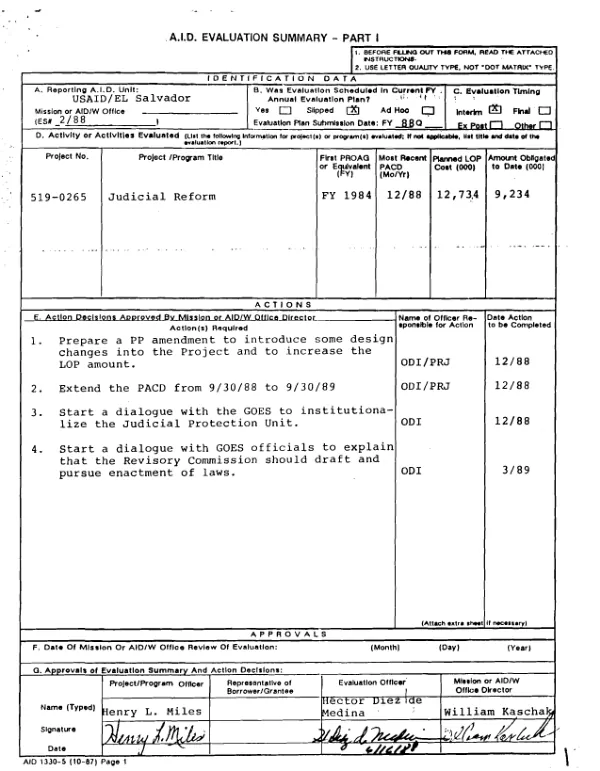
Summarizes midterm evaluation (unattached) of a project to help the Government of El Salvador (GOES) reform and modernize its criminal justice system.
1988
Sign in to readA free account is required to download.
Abstract
The evaluation covers the period FY84-3/88. The staff of the project-supported Special Investigation Unit (SIU) and the Forensic Unit appear to have been well selected, although military staffing of the units has had several negative effects. (1) Military management style does not seem conducive to optimum investigative efficiency and effectiveness. For example, detectives are not permitted to give feedback which could be valuable to officers. (2) Personnel may be transferred to military duty at any time, thus jeopardizing the investment in training. (3) Due to career pressures, SIU staff seem reluctant to investigate military complicity in crimes, particularly of senior military advisors. (4) Merely the appearance of military partiality is likely to undermine the units" credibility. The case load of the units is relatively low by U.S. standards, and functioning operational procedures (e.g., recordkeeping) are slow in being developed. The units are also suffering from shortage of transportation and communications equipment, attributable mostly to USAID/ES"s procurement delays. Although civilianization of the two units is recommended, the Mission commented that the current structure should be maintained for the short-term, while in the long-term the SIU should be institutionalized, probably under the Attorney General or the Supreme Court, and the Forensic Unit should be placed under the Police Academy. In the meantime, it is recommended that: (1) laws be amended to establish the SIU as an auxiliary court organ so that staff may present evidence without regard for military affiliation; (2) the forensic laboratory be relocated outside the military compound to downplay military domination of investigative activities; and (3) all participants in the justice system, especially judges and police, be educated on the use of forensic evidence. With regard to other project components, it is recommended that dialogue with the GOES be initiated as soon as possible to institutionalize the planned Judicial Protection Unit for judges, witnesses, and other vulnerable trial participants. In addition, the Legislative Revisory Commission (LRC) should: (1) initiate organic revision of the Penal Procedure Code, (2) emphasize operational aspects and drug trade problems, and (3) take a more active role in carrying out normative studies to give legal definition to the SIU and JPU. The PACD has been extended to 9/89.