USAID DEC
Judicial reform : component I Revisory Commission of El Salvador Legislation (CORELESAL)
Sign inUSAID. MISSION TO EL SALVADOR
Judicial reform : component I Revisory Commission of El Salvador Legislation (CORELESAL)
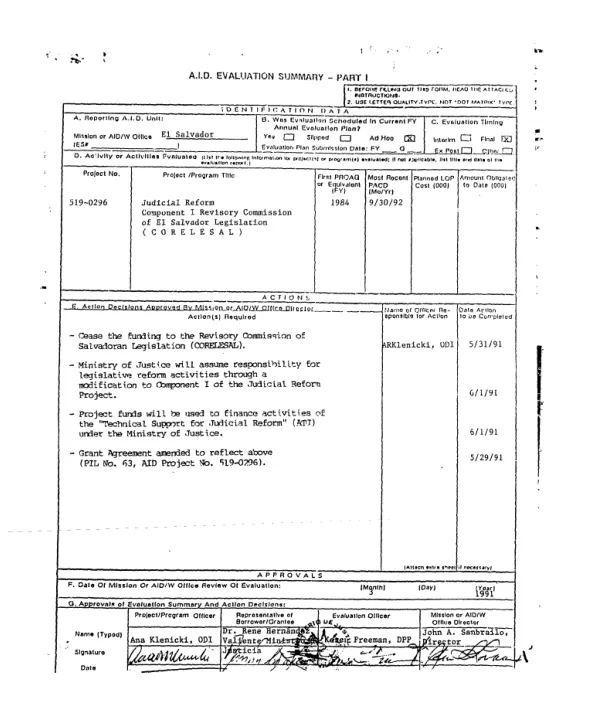
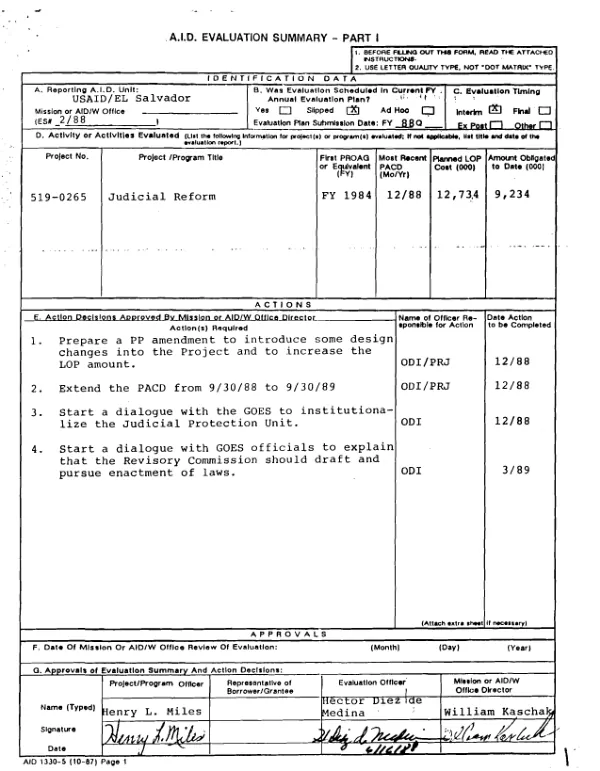
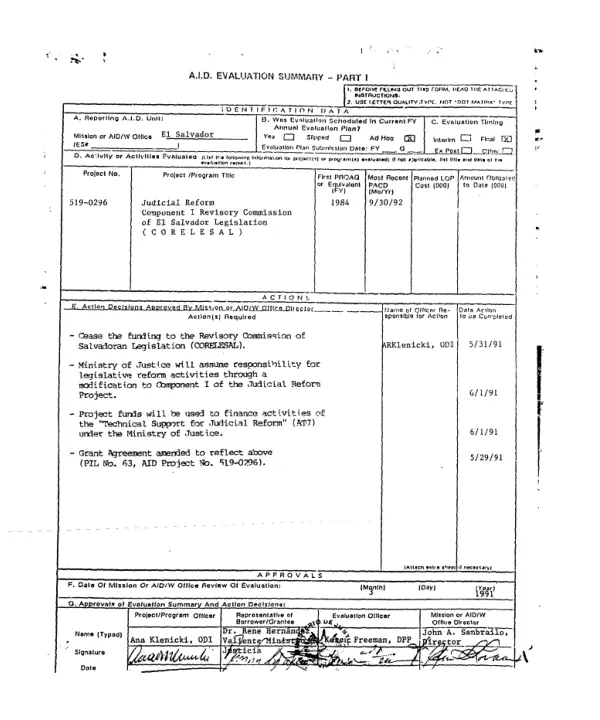
Summarizes final evaluation (XD-ABD-289-A) of a component of the Judicial Reform Project in El Salvador to establish a Revisory Commission of Salvadoran Legislation (CORELESAL) to review and revise national legislation affecting the criminal justice system.
1991
Sign in to readA free account is required to download.
Abstract
The evaluation covered the period FY84-10/90. CORELESAL was organized as a policy level body with representatives from the Executive Branch, the Ministry of Justice, the Supreme Court, that Attorney General"s Office, the Public Defender"s office, the Ministry of Defense, the bar associations, and the law schools. This diverse representation was devised in order to guarantee a thorough airing of proposals by the groups most involved in the system, and to promote an apolitical approach to the reform process. Under the Commission was a technical group in charge of actually drafting the legislation. Some of the best legal minds in the country were hired as part of this technical body. Despite a rather high level of productivity on the part of CORELESAL (in areas other than criminal justice), and a recent increase in the amount of legislation which it had drafted being passed by the legislature, CORELESAL"s has not had a fundamental impact on the country"s criminal justice system due to five main problems. (1) The legal framework established by the Salvadoran Constitution does not permit major improvements without amending the Constitution itself, which CORELESAL did not see as its mandate. (2) The structure of the judicial system is politicized, and CORELESAL, again, did not see it as its responsibility to make the Constitutional changes necessary to alter this structure. (3) The presence of Supreme Court members on CORELESAL seemed to inhibit other members from openly discussing controversial issues;, since its membership changed in 1989, the Supreme Court seemed to be distorting CORELESAL"s work to support its own political purposes. (4) CORELESAL became isolated and closed to outside suggestions. It seems reluctant to take on difficult reform issues, and in many cases, unwilling to accept the recommendations of its technical body. (5) The country"s highly politicized atmosphere makes it difficult for any group to achieve fundamental reforms in the justice system. Lessons learned included the following. (1) The presence of the Supreme Court needs to be lessened in order to guarantee independent and nonpolitical work. (2) Wide participation must be insured when discussing future legislation. (3) CORELESAL needs to work closely with a representative of the Executive branch in order to attain speedier action by the National Assembly when considering proposed legislation. (4) CORELESAL should receive long-term expatriate TA to bring it substantive knowledge in a politically neutral way. Despite these recommendations, USAID/ES has decided to cease funding CORELESAL. The Ministry of Justice will assume responsibility for legislative reform.
Related documents