MINISTRY OF HEALTH
K4Health Malawi_Monthly Update_June 2010
The K4Health Malawi program aimed to improve reproductive health and family planning services in Malawi.
2010 · 5 pages
Sign in to readA free account is required to download.
Abstract
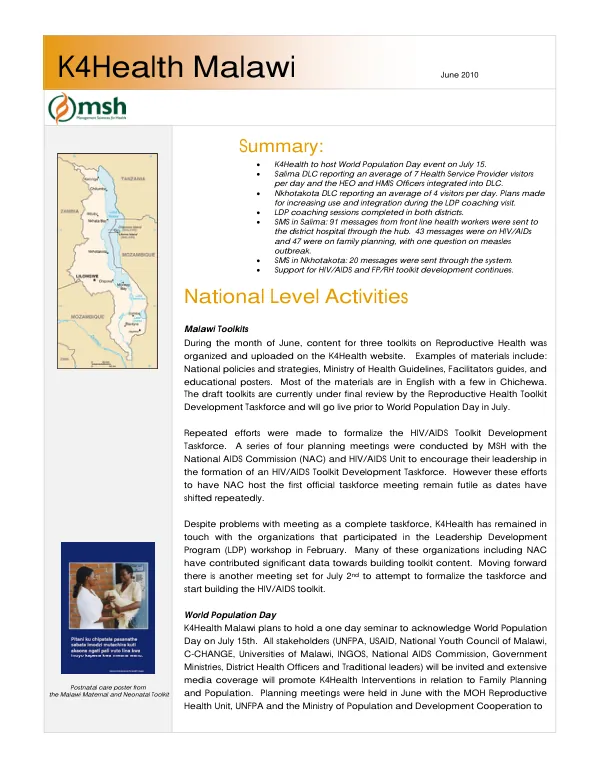
In June 2010, content for three toolkits on reproductive health was organized and uploaded on the K4Health website. The toolkits included national policies and strategies, Ministry of Health guidelines, facilitator guides, and educational posters, with most materials in English and a few in Chichewa. The program also focused on developing an HIV/AIDS toolkit, with repeated efforts made to formalize the HIV/AIDS Toolkit Development Taskforce. A series of four planning meetings were conducted by Management Sciences for Health (MSH) with the National AIDS Commission (NAC) and HIV/AIDS Unit to encourage their leadership in the formation of the taskforce. Despite problems with meeting as a complete taskforce, K4Health remained in touch with organizations that participated in the Leadership Development Program (LDP) workshop in February, and many contributed significant data towards building toolkit content. In June, K4Health Malawi planned to hold a one-day seminar to acknowledge World Population Day on July 15th. All stakeholders, including UNFPA, USAID, National Youth Council of Malawi, C-CHANGE, Universities of Malawi, INGOS, National AIDS Commission, Government Ministries, District Health Officers, and Traditional leaders, were invited, and extensive media coverage was planned to promote K4Health interventions in relation to family planning and population. The program also focused on improving health services in two districts, Salima and Nkhotakota. In Salima, the district learning center (DLC) reported an average of 7 health service provider visitors per day, and the health extension officer (HEO) and health management information system (HMIS) officers were integrated into the DLC. In Nkhotakota, the DLC reported an average of 4 visitors per day, and plans were made to increase use and integration during the LDP coaching visit. The LDP coaching sessions were completed in both districts, and SMS was used to send messages from front-line health workers to the district hospital through the hub. In Salima, 91 messages were sent, with 43 on HIV/AIDS and 47 on family planning, and one question on measles outbreak. In Nkhotakota, 20 messages were sent through the system. The program also continued to support HIV/AIDS and family planning/reproductive health (FP/RH) toolkit development. The strengths of the DLC in Salima included reliable internet connectivity, supportive staff, and adequate computers and printers. The DLC in Nkhotakota also had adequate computers and printers, but had some challenges with internet connectivity and staff availability. The program aimed to improve the capacity of health workers in both districts, with a focus on building their knowledge and skills in reproductive health and family planning.
Related documents