JOHNS HOPKINS UNIVERSITY
Family Planning Dashboard: Improving Access to Family Planning Data in Malawi
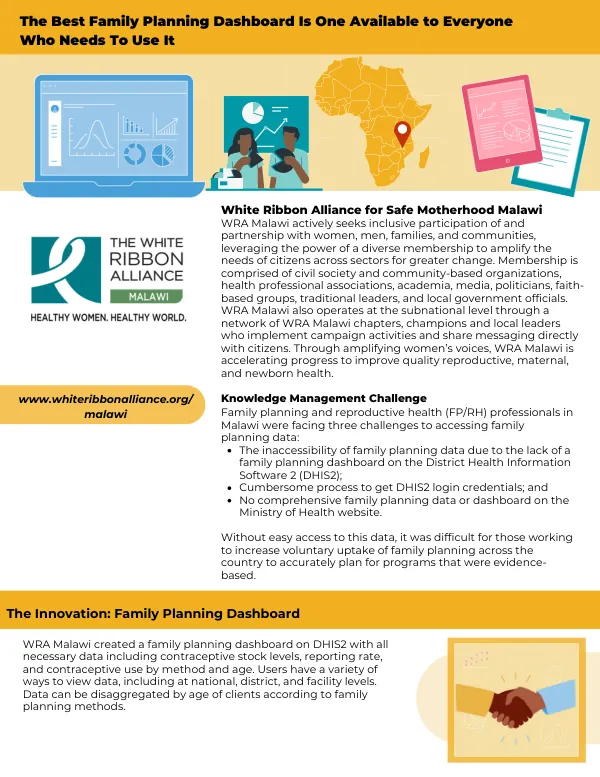
The White Ribbon Alliance for Safe Motherhood Malawi (WRA Malawi) identified three significant challenges faced by family planning and reproductive health (FP/RH) professionals in Malawi: the inaccessibility of family planning data due to the lack of a family planning dashboard on the District Health Information Software 2 (DHIS2), the cumbersome process to obtain DHIS2 login credentials, and the absence of comprehensive family planning data or a dashboard on the Ministry of Health website.
2021 · 3 pages
Sign in to readA free account is required to download.
Abstract
These challenges hindered the ability of FP/RH professionals to accurately plan programs that were evidence-based, thereby limiting their capacity to increase voluntary uptake of family planning across the country. WRA Malawi, a non-governmental organization that actively seeks inclusive participation and partnership with various stakeholders, recognized the need for a solution to address these challenges. WRA Malawi created a family planning dashboard on DHIS2, which includes essential data such as contraceptive stock levels, reporting rates, and contraceptive use by method and age. The dashboard allows users to view data at national, district, and facility levels, and it can be disaggregated by age of clients according to family planning methods. Additionally, WRA Malawi developed an external dashboard using Tableau Public, which is available on the Ministry of Health website, enabling wider access to the data without requiring DHIS2 login credentials. The development of the family planning dashboard was a collaborative effort involving WRA Malawi, the Ministry of Health, and other stakeholders. Meetings were held with officials from key departments of the Ministry of Health, as well as selected district-based civil society organizations and family planning coordinators, to develop ideas for the dashboard design. A consultant was hired to create the dashboard on DHIS2 and develop a public replica using Tableau Public. Stakeholders helped develop and test the user-friendly family planning dashboard and develop instructions for its use. The dashboard was launched in November 2021 at an event attended by the First Lady of Malawi and the Minister of Gender, Community Development and Social Welfare. To promote the dashboard's use and ensure users could easily understand how to navigate through it, WRA Malawi developed print and virtual factsheets, as well as a video. The dashboard has been endorsed by the Safe Motherhood Technical Working Group and approved by the Ministry of Health, which will maintain the dashboard moving forward. The success of the family planning dashboard is attributed to developing strong linkages and collaboration with the government, civil society partners, end users, and development partners. Essential elements of success included clearly agreeing on roles and responsibilities of each department and stakeholder, leveraging everyone's skills, and avoiding duplication of efforts. Recognizing and involving end users as much as possible was also crucial to get feedback on ways to improve the innovation and ensure ownership. The family planning dashboard is expected to have a significant impact on FP/RH professionals, enabling them to have data readily available and easily accessible to use in programming, stock management, advocacy, and decision-making. The dashboard will also facilitate the monitoring of progress towards the FP2030 commitments and targets. WRA Malawi will continue to promote the use of the dashboard and monitor its maintenance, as well as coordinate with other departments for additional support as needed.
Related documents