USAID DEC
Kabul City Initiative (KCI): Annual Report (Base Year) October 1, 2010 - September 30, 2011
Sign inISLAMIC REPUBLIC OF AFGHANISTAN
Kabul City Initiative (KCI): Annual Report (Base Year) October 1, 2010 - September 30, 2011
The Kabul City Initiative (KCI) is a comprehensive urban development project implemented in Kabul, Afghanistan.
2011 · 8 pages
Sign in to readA free account is required to download.
Abstract
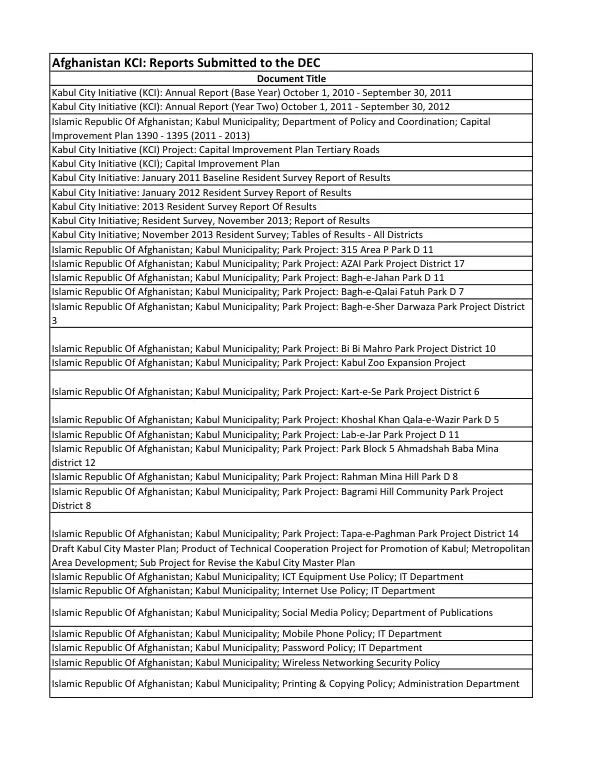
The project's primary objective is to improve the city's infrastructure, services, and overall quality of life for its residents. The KCI is a collaborative effort between the Islamic Republic of Afghanistan, the Kabul Municipality, and various international partners. The KCI's scope encompasses a wide range of initiatives, including the development of tertiary roads, parks, and public spaces. The project also focuses on improving the city's sanitation, waste management, and environmental sustainability. Additionally, the KCI aims to enhance the city's economic development through the promotion of business and trade, as well as the creation of job opportunities. The KCI's implementation is guided by a set of policies and procedures, which are designed to ensure the effective management of the project's resources and activities. These policies cover various aspects, including asset management, procurement, financial management, and human resources. The KCI also places a strong emphasis on transparency, accountability, and good governance, with a focus on preventing corruption and promoting public participation. The KCI's impact is being monitored and evaluated through a series of surveys and assessments, which provide valuable insights into the project's progress and effectiveness. The surveys cover various aspects, including the quality of life, access to services, and economic development. The data collected from these surveys is used to inform the project's decision-making and to identify areas for improvement. The KCI's geographic focus is on the city of Kabul, with a particular emphasis on the development of its tertiary roads, parks, and public spaces. The project's timeframes are aligned with the city's development plans, with a focus on achieving tangible results within a specified period. The KCI's recommendations are based on the project's findings and are designed to inform the city's future development plans and policies. The KCI's policies and procedures are designed to be flexible and adaptable, allowing for adjustments to be made in response to changing circumstances. The project's standard operating procedures (SOPs) provide a clear framework for the implementation of its policies and activities. The SOPs cover various aspects, including asset management, procurement, financial management, and human resources. The KCI's policies and procedures are aligned with international best practices and standards, ensuring that the project is implemented in a transparent, accountable, and sustainable manner. The project's focus on good governance, transparency, and accountability is designed to promote public trust and confidence in the city's institutions and services.