KABUL MUNICIPALITY
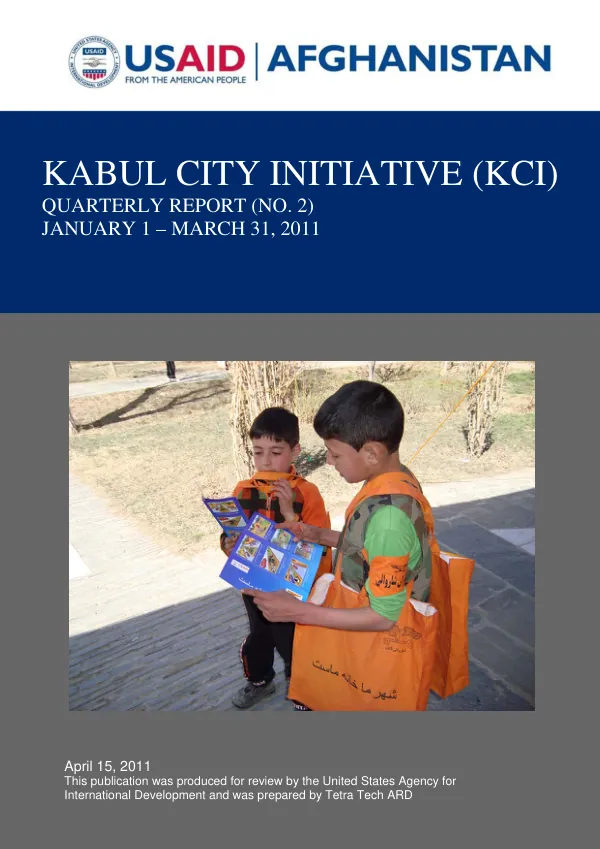
Kabul City Initiative (KCI) Quarterly Report: January 1 – March 31, 2011
The Kabul City Initiative (KCI) supports the Kabul Municipality and its Mayor in three important ways.
2011 · 39 pages
Sign in to readA free account is required to download.
Abstract
KCI increases the capacity of city officials to manage the city's resources, both human and material, to improve the level of services, to enable the participation of Kabul citizens in the determination of services to be provided, and to communicate with citizens so they are aware of the improvements and credit the city administration with these accomplishments. KCI assists the city staff to markedly improve the level and quality of services provided, and it increases the ability of the city to generate its own revenues to fund the increased level of services that new management capacity makes possible. The Kabul City Municipality is a unique government entity in Afghanistan consisting of a central administration and 22 administrative districts. KCI has embedded its project leadership and half its staff with the Mayor and his deputies at the Kabul Municipality, in each of the 22 districts, and in all of its operating departments. KCI staff is now working side by side with city officials on a daily basis. During the second quarter, KCI organized nine working groups of Kabul Municipality managers from all 22 administrative districts who met regularly to collaborate to improve municipal management and capacity, and to strengthen financial management and improve revenue collections. All District Managers and Directors General also participated in the weekly Project Oversight and Donor Coordination meeting with the Mayor. Service Delivery project concepts totaling approximately $15 million and covering 14 of the 22 districts were presented to and approved by the Mayor during these weekly meetings. Twenty-nine Service Delivery Fund project concepts totaling $15 million have been approved at the Mayor's Project Oversight and Donor Coordination meeting and are in various stages of implementation. Phase one of the Kabul Municipality ICT strategy has been approved and is being implemented. A new Kabul Municipality Chart of Accounts has been developed and adopted by the Kabul Municipality. Twenty-two process maps have been developed for six revenue and seven financial work processes. KCI helped organize the KM's International Women's Day celebration with over 3,000 participants, and also assisted the KM with four public participation activities. The baseline Organizational Management Assessment and the baseline Public Opinion Survey have been completed. Innovative management systems, such as procedures for assessing employee skill gaps and developing training plans, have been developed and implemented. The KCI team has also provided technical assistance to the Kabul Municipality on financial management, revenue collection, and service delivery. The team has worked closely with the Mayor and his deputies to develop and implement a comprehensive municipal management plan, which includes strategies for improving revenue collection, enhancing service delivery, and strengthening financial management. The KCI team has also conducted a series of training sessions for city officials on topics such as financial management, revenue collection, and service delivery. These training sessions have been well-received by city officials and have helped to build their capacity to manage the city's resources effectively. The KCI team has also provided technical assistance to the Kabul Municipality on the development of a municipal IT strategy, which includes plans for implementing a new financial management system and improving the city's ability to collect revenue. Overall, the KCI has made significant progress in supporting the Kabul Municipality and its Mayor in improving the level of services provided to citizens, strengthening financial management, and increasing revenue collection. The KCI team has worked closely with city officials to develop and implement a comprehensive municipal management plan, which includes strategies for improving revenue collection, enhancing service delivery, and strengthening financial management.