CHEMONICS
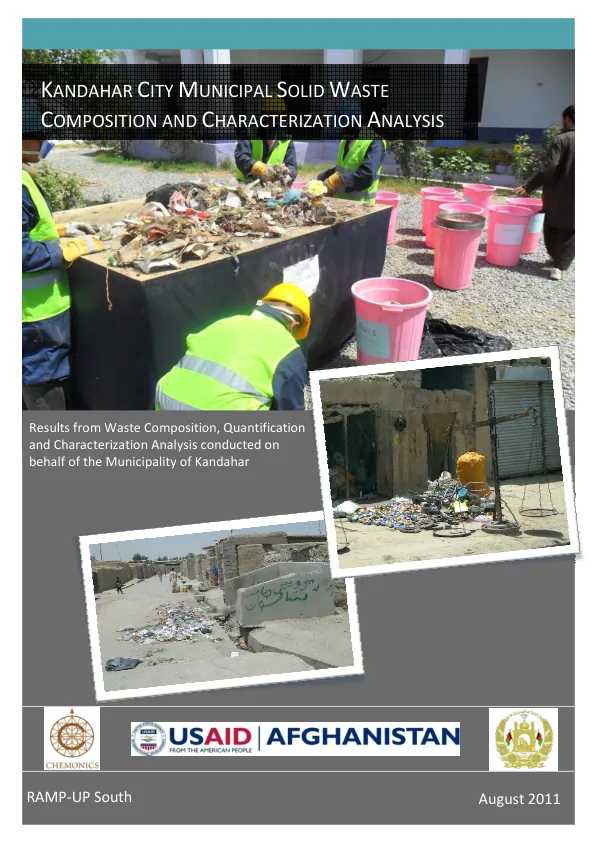
Kandahar City Municipal Solid Waste Composition and Characterization Analysis
Kandahar city, as with most urban conurbations within Afghanistan, is facing many challenges in the Municipal Solid Waste (MSW) management sector.
2011 · 74 pages
Sign in to readA free account is required to download.
Abstract
Urban population expansion, economic growth coupled with increased waste production, dilapidated waste handling equipment due to lack of investment, and limited financial, institutional, human, and infrastructural resources result in an ineffective municipal waste management system with associated adverse environment, health and safety impacts. Waste collection coverage throughout Kandahar is severely limited and ineffective, no sanitary or environmentally controlled waste disposal or treatment facilities and where waste is deposited in an open dump site which is largely undefined, uncontrolled, unregulated, and unmanaged with no environmental control. A thorough knowledge of the quantities generated, the composition of wastes and its characteristics is essential to plan, design a waste management improvement plan and operate a solid waste management system. Waste composition analysis provides information about the types and amounts of the materials that are in a given waste stream. Such analysis is essential for the following reasons: it provides the basic data on which the management system is planned, designed and operated; it provides the information for the selection of equipment and appropriate technology; it indicates the amount and type of material suitable for processing, recovery and recycling as well as the choice of a suitable method of disposal; it forecasts trends assisting designers and manufacturers in the production of vehicles and equipment suitable for future needs; and it provides a determination of the environmental impact exerted by the wastes if they are improperly managed. The waste composition and characterization study is focused on municipal solid waste which arises from family houses and commercial premises. The study collected samples from the locations detailed in the following table and according to the schedule detailed in Annex 2, Methodology. The locations included high income residential districts, medium income residential districts, low income residential districts, non-food goods commercial districts, food market commercial districts, and large, multi-product commercial districts. The study also included a disposal site at the Tarnak river. The population of Kandahar city is approximately 1,109,990, with 113,400 households. Waste is produced by family houses, commercial premises, public institutions, ISAF/Afghan security bases, international organizations, and street and ditch clearing operations. The average members per household is 10 persons. The study collected samples from individual households and community bins in each of the strata sampling locations. The methodology used for the waste composition and characterization analysis involved physically separating the waste into a number of predetermined categories. Each category was then weighed to quantify it and these weights collated to provide a breakdown of the total composition of waste which has been sampled. This provides a snapshot in time of the waste stream being analyzed, which the results of are summarized within this document.