USAID DEC
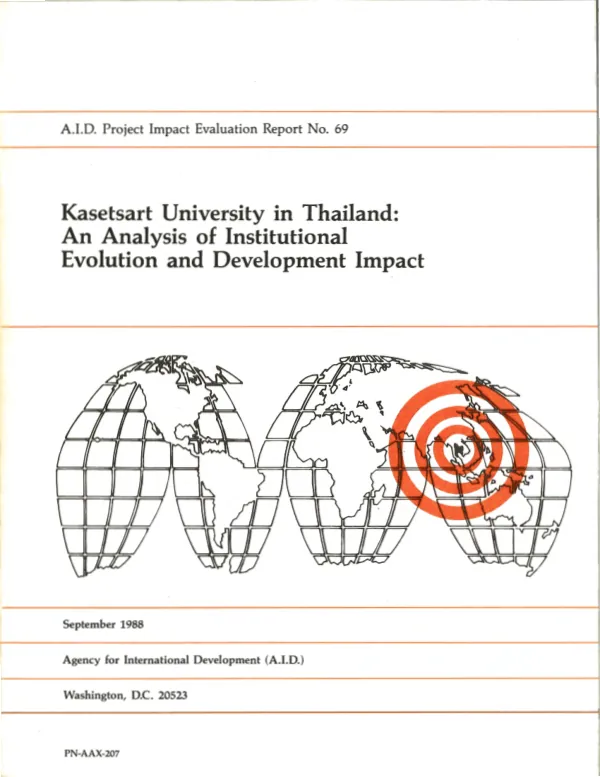
Kasetsart University in Thailand : an analysis of institutional evolution and development impact
Sign inUSAID. BUR. FOR PROGRAM AND POLICY COORDINATION. CENTER FOR DEVELOPMENT INFORMATION AND EVALUATION (CDIE)
Kasetsart University in Thailand : an analysis of institutional evolution and development impact
Founded in 1943, Kasetsart University's (KU's) original goal was to provide trained personnel to Thailand's Ministry of Agriculture and other public sector agricultural agencies.
Eriksen, John H.|Compton, J. L.|Konnerup, N. M.|Thurston, H. D.|Armstrong, G. · 1988
Sign in to readA free account is required to download.
Abstract
More than 40 years and some 38,270 graduates later, the university is entering a new phase: the transition from agricultural school to a broad-based academic institution capable of providing skilled graduates to Thailand's growing private sector. This document reviews KU's institutional development and draws valuable lessons for the development of agricultural universities in general. KU has participated in several programs which have fundamentally improved Thai agriculture. Of special interest is the National Corn and Sorghum Research Program, which has provided Thai farmers with improved maize varieties and cultural practices, resulting in a hundredfold increase in maize production. KU has also influenced the development of Thailand's world-renowned tropical fruit industry and has been instrumental in developing specialty crops such as honey, straw mushrooms, tropical orchids, and silk. KU scientists have contributed to supplying the Thai people with low-cost, high-quality protein supplements and have helped fight environmental degradation by participating in soil mapping, land use classification, and remote sensing activities. A number of lessons can be derived from KU's experience. (1) The role of agricultural higher education needs to be reconceptualized in order to enhance the relevance of agricultural schools and facilities. (2) Universities should develop strategic mechanisms for integrating diverse faculties and research programs around a common, institutional goal. (3) New forms of university organization are needed to provide more opportunities for students and faculty to engage in active, problem-oriented learning activities. (4) Universities should be held accountable for the relevance of their programs to the needs of the community. (5) The university should encourage and support leaders capable of introducing change and innovation within the university. (6) Donors and host governments should more effectively address long-term faculty development needs. (7) External donors should focus more on developing ties between the university and its outside policy, scientific, and industrial constituencies. Includes a 10-page bibliography.