USAID DEC
Keeping Vulnerable Children in School: Evidence of a Successful Community Savings Model
Sign inCHEMONICS
Keeping Vulnerable Children in School: Evidence of a Successful Community Savings Model
The Democratic Republic of Congo (DRC) faces significant challenges in providing access to education for its citizens, particularly vulnerable children.
2020 · 10 pages
Sign in to readA free account is required to download.
Abstract
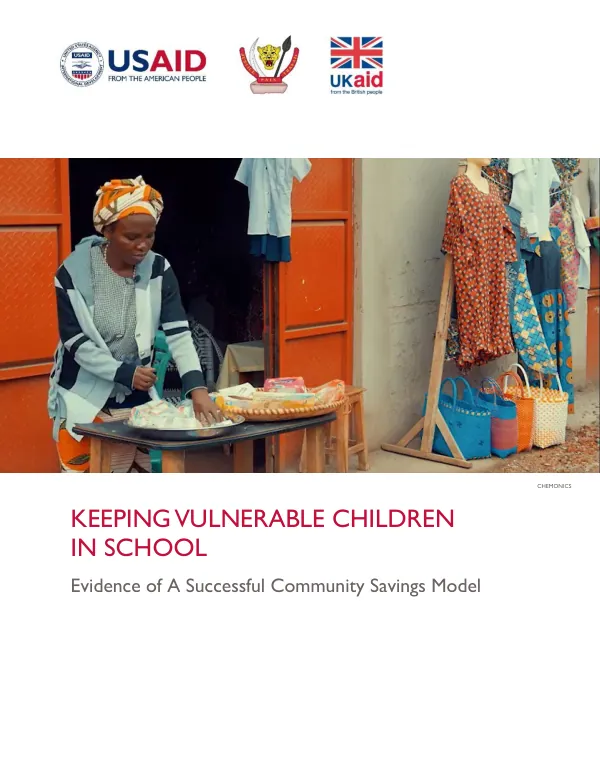
The country's poverty rate is 73 percent, and parents and households face numerous barriers to sending and keeping their children in school. The most extensive barrier is the issue of school fees, which parents in the DRC cover three-quarters of education costs. In 2013, parents financed $1.59 billion out of a total of $2.18 billion (73 percent) of education sector costs. School fees have increased significantly over the years, with levels doubling in primary and almost tripling in secondary schools between 2010 and 2016. The government uses school fees to cover teacher salaries, which are lower than in other public sector positions, and to support recurring operational costs such as office expenses or cleaning services at the school level. Local, provincial, and national authorities also levy arbitrary school fees, referred to as "ventilation," that have little or nothing to do with the actual operational or management costs of education. As a result, households face difficult choices, and children are often forced to work to pay for their school fees. One in four students in four sampled provinces worked to pay for their school fees, and children are routinely and frequently suspended from school because they are unable to meet payment deadlines. This leads to high repetition rates, with almost one in seven children having to repeat a school year due to the inability to pay school fees. In response to these challenges, the USAID-funded project ACCELERE!1 has developed and implemented a successful approach to reaching and keeping vulnerable children in school within crisis and conflict areas. This approach applies microfinance strategies, usually used for poverty alleviation, to tackle the issue of school fees in the DRC. ACCELERE!1 awards grants to civil society organizations (CSOs), who provide vulnerable households with in-kind "seed kits" to establish income-generating activities (IGA) and a community savings group (CSG). The community savings group approach helps parents secure a more sustainable future for their children, through education. The savings groups also receive basic training and supplies that allow members to effectively manage incoming and outgoing funds. The approach targets households with children in Accelerated Learning Programs (ALPs) to ensure that vulnerable and at-risk children are able to pay school fees. The selection criteria for household eligibility include whether the household has only one parent, whether a parent is sick or not able to make a living, if a child is an orphan and is in the care of extended family, or if the household is part of a local internally displaced population. The community savings group approach has shown promising results, with households able to save and manage their finances more effectively. The approach also helps to build resilience in communities and provides a more sustainable solution to the issue of school fees. By targeting vulnerable households and providing them with the necessary support and resources, ACCELERE!1's community savings group approach has the potential to make a significant impact in improving access to education for vulnerable children in the DRC. The approach has been implemented in Eastern Kasai, Central Kasai, and North and South Kivu, and has shown that it is possible to reach and keep vulnerable children in school, even in crisis and conflict areas. The community savings group approach is a promising solution to the issue of school fees in the DRC, and has the potential to be scaled up and replicated in other areas. By providing vulnerable households with the necessary support and resources, ACCELERE!1's community savings group approach can help to improve access to education for vulnerable children in the DRC and build a more resilient and sustainable education system.