BANYAN GLOBAL
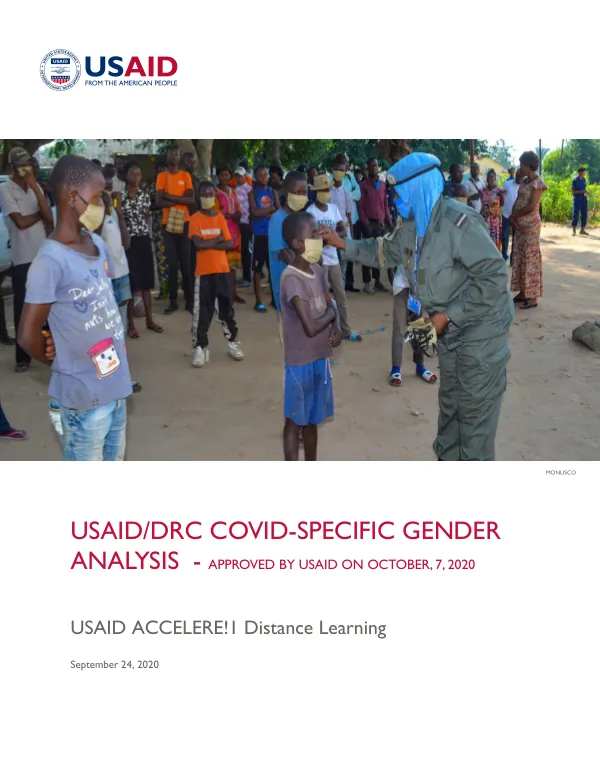
USAID/DRC COVID-SPECIFIC GENDER ANALYSIS - APPROVED BY USAID ON OCTOBER, 7, 2020
The COVID-19 pandemic has had a significant impact on the Democratic Republic of Congo (DRC), with widespread school closures and disruptions to education.
2020 · 36 pages
Sign in to readA free account is required to download.
Abstract
In response, the United States Agency for International Development (USAID) contracted Banyan Global to conduct a COVID-specific activity-level gender analysis (CSGA) for the USAID/DRC, as part of the ACCELERE!1 Distance Learning pilot activity. The analysis aimed to support USAID/DRC in integrating gender equality and women's empowerment into its programming, while preventing and mitigating the effects of COVID-19 in the distance learning activity. The analysis focused on the ACCELERE!1 pilot activity, which adapted primary education materials to the COVID-19 context and piloted a distance learning activity using interactive audio instruction (IAI) lessons broadcast on several radio channels. The pilot activity targeted primary Grades 1 and 2, as well as Level 1 in accelerated learning schools, in Kinshasa, Haut Katanga, and North Kivu provinces. An expansion of the pilot is planned for September 2020 to January or February 2021, to add lessons for Grades 3 and 4 and Level 2, and to reach Kasai Central, South Kivu, and Equateur provinces. The CSGA analysis identified several key findings and recommendations related to gender equality and women's empowerment. The pilot activity lacked gender integration in program design, staffing, and reporting, due to adaptive planning when schools were closed. The initial monitoring report did not address gender differences, although the staff provided this information for the analysis. A very small sample showed promising gender balance between female and male learners, with some disparities among the three target provinces in both formal and non-formal schools. The analysis also highlighted the need to consider the needs of children with disabilities, indigenous and LGBTI boys and girls, and to use sex-disaggregated data for adaptive management. The CSGA research team was only able to review four lesson transcripts, and only one included content to promote gender equality in awareness-raising for parents about COVID-19. There were more male than female staff and lesson instructors, reinforcing cultural norms of male dominance and female subordination. The analysis made several recommendations to enhance the integration of gender equality and social inclusion in the expansion of the activity. These include requiring a gender lens in the expansion, establishing gender-related targets, and expanding gender equality messaging in lesson content and awareness-raising sub-activities. The analysis also recommended investing in a needs assessment or consultation with representatives of key populations, such as children with disabilities, indigenous and LGBTI boys and girls, and parents of children. The CSGA analysis emphasized the importance of staff receiving yearly gender-integration training specific to the distance learning activity. Training to staff could focus on how to implement the information included in the analysis, which highlights the gendered dimensions of the pandemic. The analysis also recommended carrying out planned GBV response and enhancing mitigation measures, including an analysis of sex-disaggregated data in all monitoring reports and conducting parallel monitoring surveys or integrating key sex-disaggregated indicators into existing surveys in selected regions. Overall, the CSGA analysis provided valuable insights into the impact of the COVID-19 pandemic on education in the DRC and highlighted the need for a more inclusive and equitable approach to distance learning. The recommendations made in the analysis aim to support USAID/DRC in integrating gender equality and women's empowerment into its programming, while preventing and mitigating the effects of COVID-19 in the distance learning activity.
Related documents