CATHOLIC RELIEF SERVICES ORGANIZATION
Role of Cultivated Forages in Timor-Leste
The agricultural sector in Timor-Leste plays a crucial role in the country's economy and food security.
2023 · 64 pages
Sign in to readA free account is required to download.
Abstract
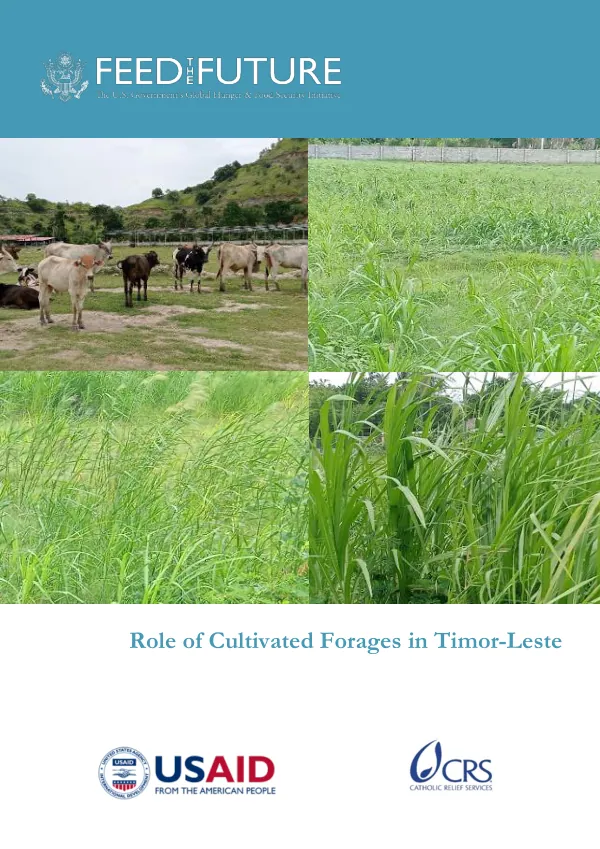
Animal feeding is a significant component of this sector, with forages serving as a primary source of nutrition for livestock. The Feed the Future Global Supporting Seed Systems for Development Activity, implemented by Catholic Relief Services, aimed to strengthen linkages and coordination of seed development efforts through consolidation of data and evidence. Animal feeding in Timor-Leste is characterized by a reliance on imported feed ingredients, which can be costly and unreliable. The country's livestock production systems are also vulnerable to drought and flood, which can have devastating impacts on animal health and productivity. To address these challenges, the S34D study focused on the role of cultivated forages in Timor-Leste, with the goal of improving animal nutrition, reducing reliance on imported feed, and enhancing the resilience of livestock production systems. The study gathered data and information on forage seed development and livestock production systems in Timor-Leste, including macroeconomic indicators, nutritional, economic, and environmental data, and forage survey data. A SWOT analysis was conducted to identify the strengths, weaknesses, opportunities, and threats associated with forage seed development in the country. The study also examined the partnership landscape and project information related to forage seed development in Timor-Leste. The study estimated the annual forage seed requirement for Timor-Leste, taking into account the country's livestock population and the demand for roughages. The selected forage species for the study were lablab, napier grass, and leucaena, which were chosen for their high nutritional value and adaptability to Timor-Leste's climate. The study estimated that the country requires approximately 1,500 metric tons of forage seed per year to meet the demand for roughages. The study also conducted nutritional, economic, and environmental assessments of the selected forage species. The nutritional evaluation revealed that lablab, napier grass, and leucaena are high-quality forages that can provide essential nutrients for dairy animals. The economic analysis showed that cultivated forages can be a cost-effective alternative to conventional feed ingredients, with a lower cost of production and a higher profit per hectare. The environmental impact evaluation revealed that cultivated forages can help reduce the country's reliance on imported feed and mitigate the environmental impacts associated with livestock production. The study concluded that cultivated forages can play a critical role in improving animal nutrition, reducing reliance on imported feed, and enhancing the resilience of livestock production systems in Timor-Leste. The study recommended that the government and private sector stakeholders prioritize the development of forage seed systems, invest in research and development, and promote the adoption of cultivated forages among livestock producers.
Related documents