ICF
L’Enquête sur les Indicateurs du Paludisme au Sénégal en 2020-2021 (EIPS-2020-2021)
The L'Enquête sur les Indicateurs du Paludisme au Sénégal en 2020-2021 (EIPS-2020-2021) aims to collect, analyze, and disseminate indicators related to the population and the domain of malaria in Senegal.
2021 · 1 pages
Sign in to readA free account is required to download.
Abstract
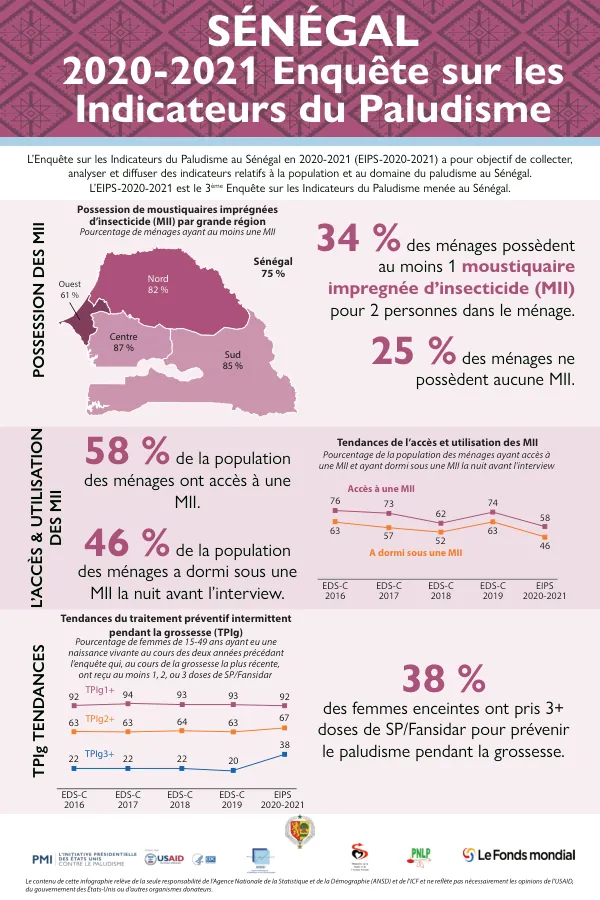
This is the third Malaria Indicators Survey conducted in Senegal. Thirty-eight percent of pregnant women received three or more doses of SP/Fansidar to prevent malaria during pregnancy. Thirty-four percent of households possess at least one insecticide-treated mosquito net (MII) for two people in the household. Twenty-five percent of households do not possess any MII. Access and utilization of MII trends show that 58% of the population of households have access to a MII. Forty-six percent of the population of households slept under a MII the night before the interview. The access and utilization of MII trends indicate that the percentage of the population of households having access to a MII and having slept under a MII the night before the interview has fluctuated over time. In 2016, 76% of households had access to a MII and 75% of households slept under a MII. By 2020-2021, these percentages decreased to 58% and 46%, respectively. Regional trends in MII possession show that the possession of MII varies by region. In 2020-2021, 82% of households in the North region possessed at least one MII, while 61% of households in the West region possessed at least one MII. The trend of preventive intermittent treatment during pregnancy (TPIg) shows that the percentage of women aged 15-49 who had a live birth in the two years preceding the survey and received at least one, two, or three doses of SP/Fansidar during the most recent pregnancy has fluctuated over time. In 2016, 92% of women received three or more doses of SP/Fansidar, while in 2020-2021, 38% of women received three or more doses.
Related documents