USAID DEC
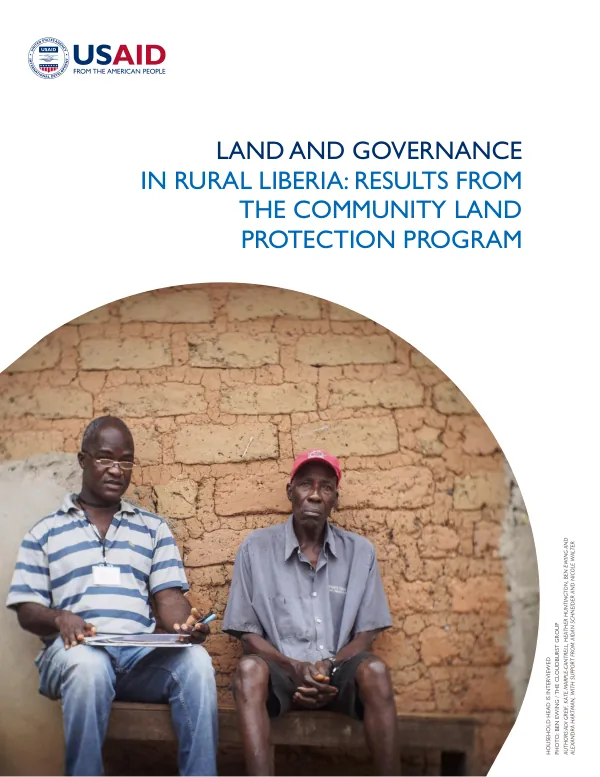
Land and Governance in Rural Liberia: Results from the Community Land Protection Program
Sign inDEPARTMENT FOR INTERNATIONAL DEVELOPMENT
Land and Governance in Rural Liberia: Results from the Community Land Protection Program
The Community Land Protection Program in rural Liberia aimed to empower communities to govern their land autonomously and progressively.
2018 · 10 pages
Sign in to readA free account is required to download.
Abstract
The program, implemented by the Sustainable Development Institute, focused on community land rights and provided education on rights and responsibilities in decentralized land management. The intervention consisted of three components: community empowerment, boundary harmonization and conflict resolution, and fostering good governance. Community empowerment included provision of legal education on rights and responsibilities in the context of decentralized land management. Boundary harmonization and conflict resolution involved comprehensive mapping of community land, negotiation with neighbors, and boundary demarcation. Fostering good governance included discussing and adopting rules for community land and natural resource management, electing a diverse, permanent, and accountable governing body, and strengthening the rights of marginalized groups and women to participate. The program was implemented in rural Lofa, Maryland, and River Gee counties, with a panel survey dataset of household heads collected at baseline and midline. The evaluation team collected 683 household observations and 36 community observations at baseline, and 818 household observations and 43 community observations at midline. Three community leaders completed the leaders' survey in each town at baseline and midline, and the field team conducted three focus group discussions in each town where data was collected at midline. The evaluation found that the Community Land Protection Program had a striking effect on how community members perceived their leaders in treatment communities. Community members in treatment communities reported increased participation in land governance activities, with poor respondents, youth, and members of minority groups showing improved participation on some measures. However, longer-term data collection is needed to fully understand the effects of the intervention on tenure security, local empowerment, resource governance, and livelihoods. The program's boundary harmonization process was widely satisfactory among community members, with respondents reporting increased participation in land governance activities. However, the evaluation noted that scaling up these program components across Liberia would be beneficial. The program's focus on community land rights and education on rights and responsibilities in decentralized land management was seen as a key factor in its success. The Community Land Protection Program's evaluation addressed the broader question of the effectiveness of skills-building, training, and technical support interventions by outside actors. The program's approach, which focused on shifting norms and building capacity rather than providing material benefits, was seen as a key factor in its success. The evaluation's findings provide important evidence to support the premise of the CLPP intervention that land governance programs are most successful when they involve long-term and ongoing support, training, and capacity building for communities. The program's implementation was delayed due to the outbreak of the Ebola virus in Liberia, and the evaluation team noted that the results may not be representative of the entire population due to the smaller sample size. However, the primary results considered in this brief are likely acceptable, and the evaluation provides a rigorous assessment of the program's effectiveness.
Related documents