EXETER ASSOCIATES, INC.
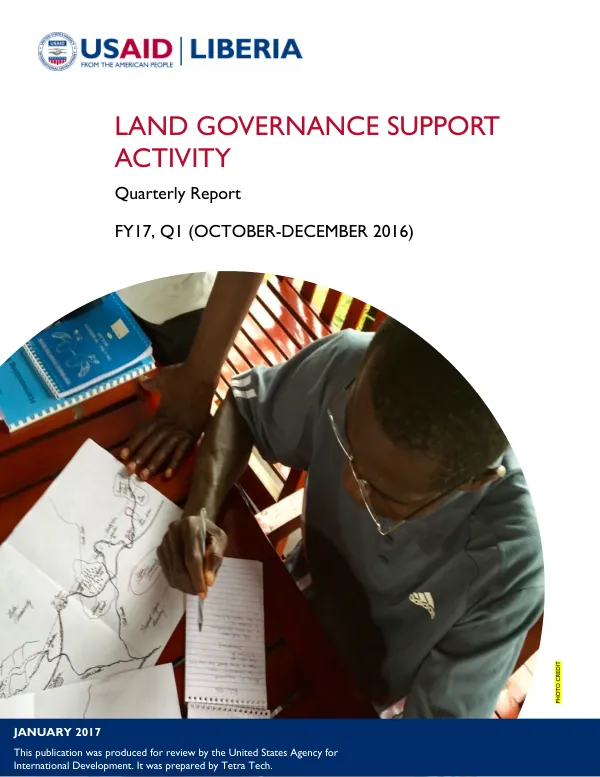
Land Governance Support Activity Quarterly Report FY17, Q1
The Land Governance Support Activity (LGSA) is a project implemented by Tetra Tech, in collaboration with Landesa, Namati, CDR Associates, Sustainable Development Institute, and Parley, under the Strengthening Tenure and Resource Rights (STARR) Indefinite Delivery/Indefinite Quantity Contract.
2017 · 42 pages
Sign in to readA free account is required to download.
Abstract
The project aims to support the establishment of more effective land governance systems in Liberia, enabling comprehensive reforms to improve equitable access to land and security of tenure. The project's year two work plan continues to support USAID's engagement in the sector. The Liberia Land Authority Act was passed by the legislature and signed into law by the President in early October, but no appointments of Commissioners or a Transition Committee were made by the end of the quarter. Despite this, LGSA continued to implement components of its year two work plan, focusing on two broad Activity objectives: the land governance structure and the development and testing of a methodology for implementation of the Land Rights Policy (Law). The LGSA Land Governance Advisor and Land Administration Specialist developed a draft organizational structure for the Liberia Land Authority, which delineates the functions of each department and unit, as well as staffing requirements. This draft organizational structure was completed during the quarter. Additionally, LGSA finalized an implementation strategy for the transition team, which will become a working document for the Transition Committee once it is established. During the first year of LGSA, the project developed a set of research topics to inform the process for recognition of customary land. Seven broad research topics were identified, and research was undertaken on six of the seven. A two-day workshop was hosted in early November, focused on research findings and the next steps for LGSA activities around the process for recognition of customary land. Partners presented findings of studies on boundary identification and negotiations, current land dispute resolution models, models for community land governance, women's land rights, definition of community membership, and the political ecology of land and agriculture concessions in Liberia. The project's work plan continues to focus on the operationalization of the Liberia Land Authority, the development and testing of a methodology for implementation of the Land Rights Policy (Law), and the strengthening of civil society, private sector, and citizen engagement in land governance. The project aims to support the Government of Liberia, civil society, and communities in their land rights reform process, with the ultimate goal of facilitating inclusive sustained growth and development, ensuring peace and security, and providing sustainable management of the environment. The project's quarterly report highlights the progress made in the first quarter of FY17, including the development of a draft organizational structure for the Liberia Land Authority, the finalization of an implementation strategy for the transition team, and the hosting of a workshop on research findings related to customary land recognition. The report also highlights ongoing research activities and the project's continued focus on supporting the Government of Liberia's land rights reform process. The project's work is guided by a collaborative team of technical and organizational assistance providers, including Tetra Tech, Landesa, Namati, CDR Associates, Sustainable Development Institute, and Parley. The project's success depends on the effective implementation of its work plan, the operationalization of the Liberia Land Authority, and the development and testing of a methodology for implementation of the Land Rights Policy (Law). The project's geographic focus is on Liberia, with a specific emphasis on supporting the Government of Liberia's land rights reform process. The project's timeframes are guided by the USAID/Liberia contract, with a focus on delivering results within the first year of implementation. The project's recommendations are based on the research findings and the next steps for LGSA activities around the process for recognition of customary land. The project's implementation details are guided by a collaborative team of technical and organizational assistance providers, including Tetra Tech, Landesa, Namati, CDR Associates, Sustainable Development Institute, and Parley. The project's monitoring and evaluation framework is designed to track progress against the project's work plan and to identify areas for improvement. The project's success will be measured by the effective implementation of its work plan, the operationalization of the Liberia Land Authority, and the development and testing of a methodology for implementation of the Land Rights Policy (Law). The project's recommendations will be based on the research findings and the next steps for LGSA activities around the process for recognition of customary land.