DEVTECH SYSTEMS, INC.
Latin America and the Caribbean Inclusive Education Landscape Assessment
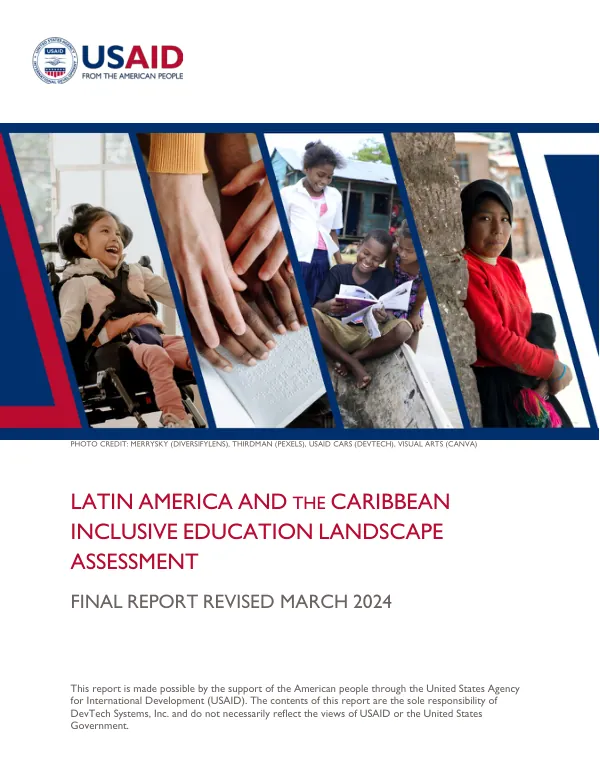
The Latin America and the Caribbean Inclusive Education Landscape Assessment is a comprehensive report that aims to understand the current state of inclusive education in the region.
2024 · 190 pages
Sign in to readA free account is required to download.
Abstract
The report was prepared by a multidisciplinary team of international consultants and is supported by the United States Agency for International Development (USAID). The assessment focuses on six research questions, including education access and learning achievement, education management information systems, inclusive education policies and practices, school environment as a determinant of education quality, family and community determinants, and multilateral support. The report provides an overview of the education system in three countries: Colombia, El Salvador, and Haiti. In Colombia, the education system snapshot reveals a complex landscape with significant disparities in education access and quality. The report highlights the importance of addressing the needs of marginalized target groups, including indigenous and Afro-Colombian communities. The assessment also emphasizes the need for improved education management information systems to better track student outcomes and inform policy decisions. In El Salvador, the education system is characterized by a high dropout rate and limited access to education for marginalized groups. The report identifies the need for more effective inclusive education policies and practices to address the needs of students with disabilities and those from low-income backgrounds. The assessment also highlights the importance of improving the school environment to enhance education quality. In Haiti, the education system is marked by significant challenges, including a high dropout rate and limited access to education for marginalized groups. The report emphasizes the need for improved education management information systems to better track student outcomes and inform policy decisions. The assessment also highlights the importance of addressing the needs of students with disabilities and those from low-income backgrounds. The report provides a range of recommendations to improve inclusive education in the region, including the development of more effective education management information systems, the implementation of inclusive education policies and practices, and the improvement of the school environment to enhance education quality. The report also emphasizes the need for increased multilateral support to address the complex challenges facing the education sector in the region. The assessment highlights the importance of addressing the needs of marginalized target groups, including indigenous and Afro-Colombian communities, students with disabilities, and those from low-income backgrounds. The report emphasizes the need for more effective inclusive education policies and practices to address the complex challenges facing the education sector in the region. The report provides a comprehensive overview of the education landscape in the region, highlighting the significant disparities in education access and quality. The assessment emphasizes the need for improved education management information systems, inclusive education policies and practices, and the improvement of the school environment to enhance education quality. The report also highlights the importance of addressing the needs of marginalized target groups and increasing multilateral support to address the complex challenges facing the education sector in the region.