INTEGRA GOVERNMENT SERVICES INTERNATIONAL, LLC
LEAP III - Uganda CBA Final Report
The Karamoja region in northeastern Uganda is a sub-region bordering South Sudan and Kenya, comprising eight districts with a population of approximately 1.2 million people.
2023 · 36 pages
Sign in to readA free account is required to download.
Abstract
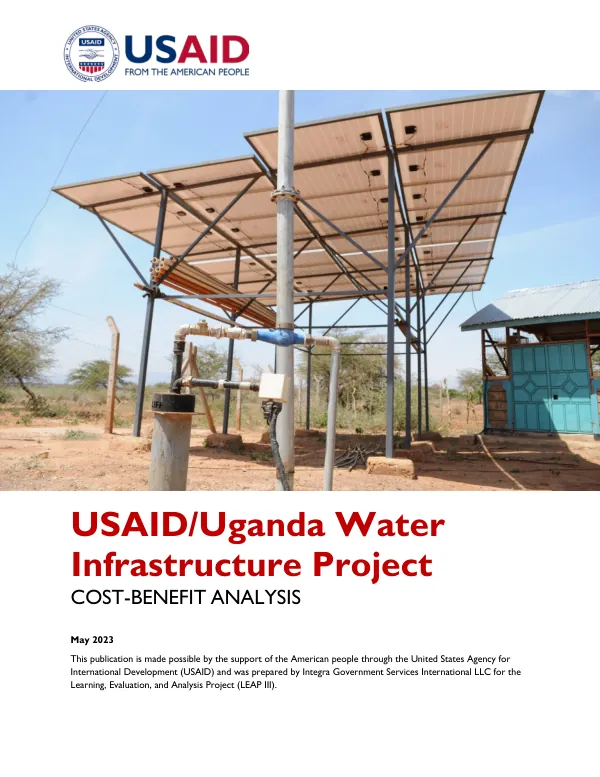
More than half of the population is comprised of women and children below the age of 18. Agriculture is the primary livelihood in the region, with 84 percent of communities reporting crop farming as the major economic activity. Most of the agriculture is subsistence, with low productivity levels relying on rainfed agriculture. Major staple food crops include cassava, millet, maize, potatoes, rice, and sorghum. Livestock rearing accounts for 10 percent of primary livelihoods, largely concentrated in the more arid climate zones of Karamoja. Karamoja is a semi-arid region with low and erratic rainfall, making it one of the driest regions in Uganda. The harsh climate and long history of conflict have contributed to the region's underdevelopment, with income poverty, food poverty, and illiteracy affecting 60 percent, 70 percent, and 68 percent of the population, respectively. Access to clean water is a significant challenge in Karamoja, resulting in a high incidence of waterborne diseases such as cholera, diarrhea, and typhoid fever. The lack of water resources has also led to low agricultural productivity and frequent food shortages, exacerbating poverty and malnutrition challenges. The dire health conditions in Karamoja are further aggravated by gender-based violence, which is often linked to water collection. Women and girls are often responsible for collecting water, and the long distances they must travel to access water sources make them vulnerable to violence and sexual assault. The lack of locally accessible water resources has far-reaching implications for the health, agricultural productivity, and safety of the Karamojong people. USAID/Uganda is considering a water infrastructure activity in Karamoja, and as a precursor to that activity, USAID/Uganda has asked the Learning, Evaluation and Analysis project (LEAP III) to conduct a cost-benefit analysis (CBA) focusing specifically on the incremental costs and benefits of four different water infrastructure technologies. The four technologies being considered are boreholes with handpumps, boreholes with solar pumps, subsurface storage (sand dams), and surface storage (valley tanks). The CBA aims to estimate the returns to investments in these technologies, taking into account the costs and benefits of each option. The analysis will consider five main streams of benefits: time to collect water benefits, health benefits, educational benefits, agricultural benefits, and gender-based violence benefits. For costs, the analysis will estimate the capital and operations and maintenance costs for each technology. The CBA model, called the Karamoja Water Access CBA Model (KWACM), was developed by the LEAP III team to estimate the returns to investments in the four technologies. The model uses different approaches, including literature review, secondary data analysis, and key-informant interviews (KIIs), to estimate the impact of each benefit and cost stream. The analysis finds that three of the four technologies have high returns, with borehole with handpump, borehole with solar pump, and sand dam all having benefit-cost ratios that exceed two. On the other hand, the valley tank has a benefit-cost ratio lower than one, driven by high upfront installation costs, suggesting that it is currently not a worthwhile investment.
Related documents