USAID
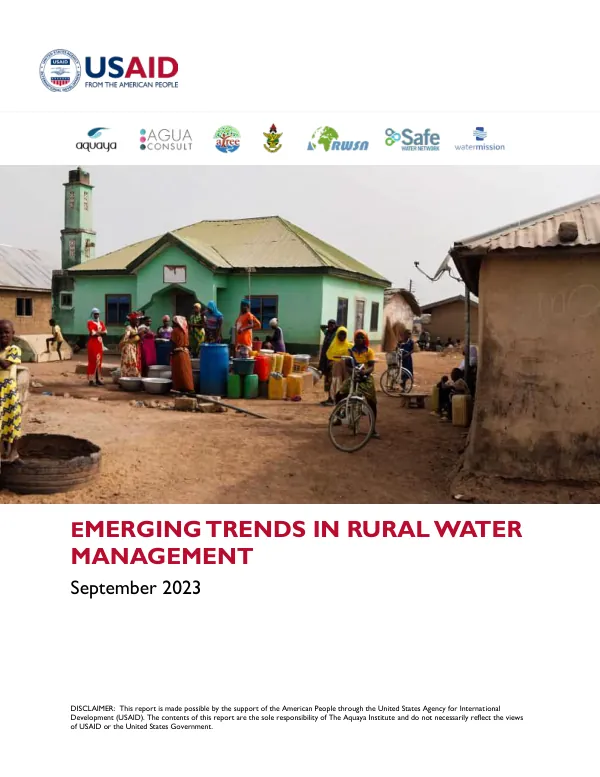
REAL-Water Semi-Annual Activity Report April 1, 2023 – September 30, 2023
The Rural Evidence and Learning for Water (REAL-Water) program is an implementation research program dedicated to building the evidence base for achieving safe, equitable, sustainable rural water supplies in low-and middle-income countries.
2023 · 55 pages
Sign in to readA free account is required to download.
Abstract
REAL-Water is supported through a Cooperative Agreement between the United States Agency for International Development (USAID) and The Aquaya Institute (Aquaya). This knowledge-building initiative contributes to the goals of USAID's Water and Development Plan, established under the U.S. government's Global Water Strategy. The REAL-Water program comprises three interrelated components: implementation research, evidence for decision-making, and USAID WASH coordination. Implementation research is a key component of the REAL-Water program, applying scientific methods, international collaboration, and rigorous analyses to address critical water and development themes. The program focuses on four research streams: Improving Rural Water Management (IMP), Strengthening Water Safety Management (WSM), Improved Planning for Water Resources (WRM), and Increased USAID Mission Access to Specialized Expertise. The IMP research stream aims to improve rural water management through the development of evidence-based solutions, while the WSM research stream focuses on strengthening water safety management through the implementation of water safety plans. The WRM research stream aims to improve planning for water resources through the development of evidence-based approaches. The REAL-Water program also places a strong emphasis on evidence for decision-making, ensuring that the evidence generated by the program reflects the needs and priorities of key stakeholders. This is achieved through the involvement of stakeholders in research question development, study design, and result interpretation. The program also aims to maximize the likelihood of uptake of knowledge generated by REAL-Water in ways that contribute to the fulfillment of REAL-Water objectives and vision. This is achieved through the dissemination of research findings to key stakeholders, including policymakers, practitioners, and researchers. The USAID WASH coordination component of the REAL-Water program focuses on supporting USAID's WASH efforts through the provision of technical assistance, research, and capacity building. The program works closely with USAID missions to identify priority areas for WASH support and to develop evidence-based solutions to address these challenges. The program also provides technical assistance to USAID missions on WASH-related issues, including water safety management, rural water supply, and sanitation. The REAL-Water program has made significant progress in the past six months, with several key accomplishments and success stories. The program has completed several research studies, including a study on the impact of water safety plans on water quality in Ghana. The program has also developed several evidence-based solutions for improving rural water management, including a toolkit for improving rural water supply systems. The program has also provided technical assistance to several USAID missions, including the USAID mission in Ghana, on WASH-related issues. The REAL-Water program has also engaged with several key stakeholders, including policymakers, practitioners, and researchers. The program has presented research findings at several international conferences, including the All Systems Connect conference in The Hague, Netherlands, and the World Water Week conference in Stockholm, Sweden. The program has also collaborated with several international organizations, including the World Health Organization (WHO) and the International Water Association (IWA). Overall, the REAL-Water program is making significant contributions to the evidence base for achieving safe, equitable, sustainable rural water supplies in low-and middle-income countries. The program's focus on implementation research, evidence for decision-making, and USAID WASH coordination has enabled it to develop evidence-based solutions to address critical water and development challenges. The program's engagement with key stakeholders has also ensured that the evidence generated by the program reflects the needs and priorities of key stakeholders.
Related documents