DAI GLOBAL, LLC
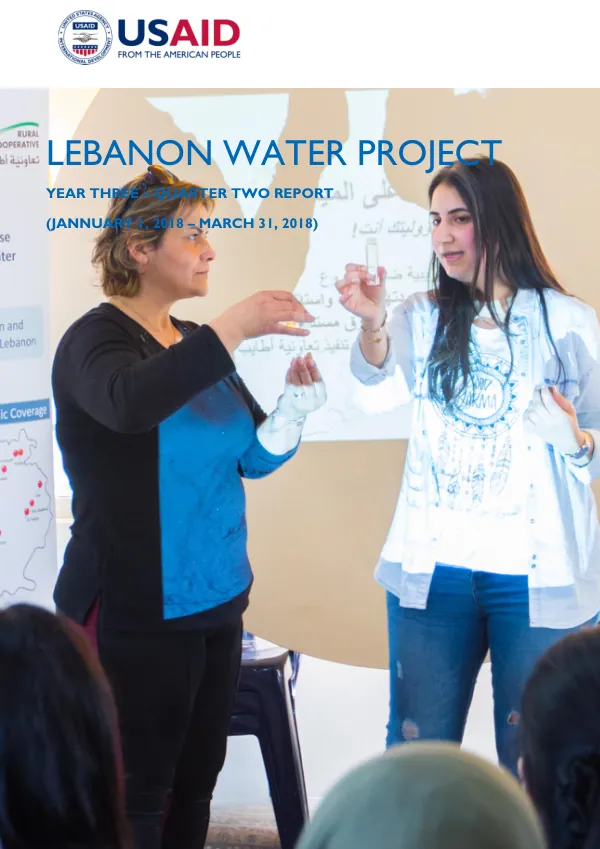
Lebanon Water Project Year Three – Quarter Two Report
The Lebanon Water Project (LWP) is a five-year activity funded by the United States Agency for International Development (USAID) with a goal to increase reliable and sustainable access to water for citizens, improve water management practices, enhance the efficiency and sustainability of the Regional Water Establishments (RWEs) and the Litani River Authority (LRA), reduce non-revenue water, and improve irrigation water use.
2018 · 78 pages
Sign in to readA free account is required to download.
Abstract
The project is implemented in partnership with the Beirut-Mount Lebanon Water Establishment (BMLWE), Beqaa Water Establishment (BWE), South Lebanon Water Establishment (SLWE), North Lebanon Water Establishment (NLWE), and LRA. The LWP aims to achieve its objectives through three interrelated results: Result A, Result B, and Result C. Result A focuses on improving service delivery and resource management by the five public water utilities (the four RWEs and the LRA) that are mandated by law to provide water, wastewater, and irrigation management services in Lebanon, and by local municipalities where feasible and appropriate. Result B seeks to improve civic engagement in water management and advance citizen perception of the water utilities' role in providing a necessary and valuable service. Result C aims to improve private sector involvement in water management. In Year Three, Quarter Two (Y3-Q2), the LWP continued its simultaneous implementation of Results A, B, and C. Through Result A, the LWP directly strengthened the RWEs and LRA from within, making them efficient in management and service delivery. Building on Result A improvements, Result B sought to restore a balanced relation between the improved RWEs and LRA and citizens through turning these citizens into responsible customers that have rights, but also obligations towards the RWEs and LRA. Finally, building on the ground laid by both Results A and B, Result C sought to remedy the existing disconnect between the public and private sectors in water management. The LWP implemented various activities in Y3-Q2, including training programs, infrastructure development, and market linkage facilitation. The project also conducted monitoring and evaluation activities to assess progress towards its objectives. The LWP worked closely with the RWEs, LRA, and local municipalities to implement its activities and achieve its objectives. The project's progress in Y3-Q2 was significant, with notable achievements in all three results. In Result A, the LWP made progress in strengthening the RWEs and LRA, including the development of new management systems and the implementation of infrastructure projects. In Result B, the LWP improved civic engagement in water management, including the establishment of citizen committees and the implementation of public awareness campaigns. In Result C, the LWP made progress in improving private sector involvement in water management, including the development of public-private partnerships and the implementation of private sector-led water management projects. The LWP also made significant progress in its management and operations, including the development of new policies and procedures and the implementation of new management systems. The project's monitoring and evaluation activities also showed significant progress towards its objectives, with notable achievements in all three results. The LWP's progress in Y3-Q2 was also reflected in its achievements in the areas of gender integration, short-term technical assistance, environmental compliance, and construction works. The project's communications and media efforts also showed significant progress, with notable achievements in public awareness and outreach. Overall, the LWP's progress in Y3-Q2 was significant, with notable achievements in all three results and in its management and operations. The project's continued implementation of its activities and achievement of its objectives will have a positive impact on the water sector in Lebanon and contribute to the country's development goals.
Related documents