SOCIAL IMPACT, INC.
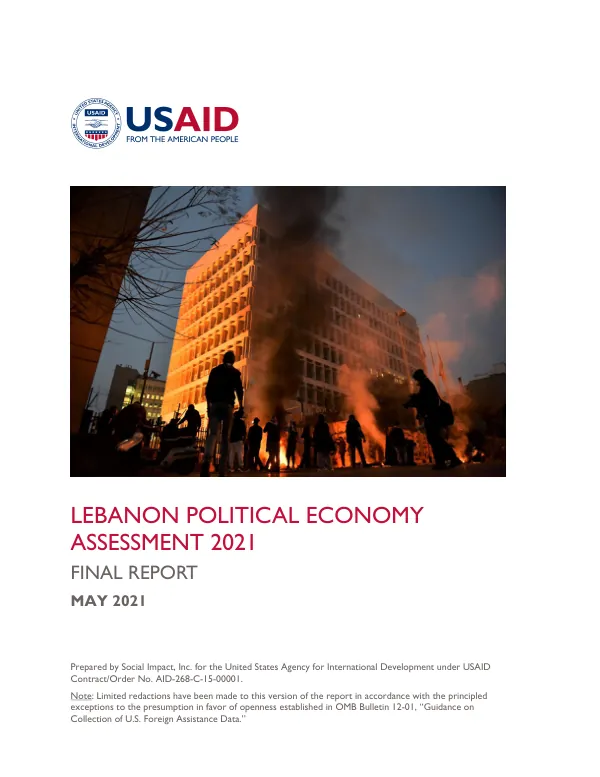
Lebanon Political Economy Assessment 2021
Lebanon's financial meltdown has been a major concern since 2019, with the country's economy experiencing a severe contraction.
2021 · 119 pages
Sign in to readA free account is required to download.
Abstract
The crisis has been exacerbated by a deep and overlapping set of challenges, including a massive public debt, a severe liquidity crisis, and a sharp decline in foreign exchange reserves. The government's inability to implement effective reforms has further exacerbated the crisis, leading to widespread protests and social unrest. The country's financial system has been severely impacted, with the Lebanese Lira (LL) experiencing a sharp decline in value against the US dollar. The Central Bank of Lebanon (BdL) has been unable to maintain the currency's peg, leading to a sharp increase in inflation and a decline in living standards. The country's banking system has also been severely impacted, with many banks facing significant losses and a sharp decline in deposits. The government's efforts to address the crisis have been hindered by a lack of consensus and a failure to implement effective reforms. The country's politicians have been unable to agree on a comprehensive reform package, and the government has been unable to implement effective measures to address the crisis. The situation has been further complicated by the COVID-19 pandemic, which has had a significant impact on the country's economy. The country's medium-term future is highly uncertain, with plausible scenarios ranging from a successful financial stabilization that paves the way for subsequent structural adjustment and broader reforms of the political economy, to state collapse with accompanying human misery and violence. The most important recommendation is that USAID approach programming on the understanding that the latter needs to be flexible and constantly re-assessed in light of changing circumstances. The country's economic growth prospects are highly uncertain, with the IMF estimating that the country's GDP will decline by 12% in 2021. The country's foreign exchange reserves are also critically low, with the Central Bank of Lebanon (BdL) estimating that the country's foreign exchange reserves will decline to $1.5 billion by the end of 2021. The country's banking system is also facing significant challenges, with many banks facing significant losses and a sharp decline in deposits. The country's human development indicators are also highly concerning, with the country's poverty rate estimated to be over 50%. The country's education and healthcare systems are also facing significant challenges, with many schools and hospitals facing significant shortages of resources and staff. The country's human development indicators are likely to decline further in the absence of effective reforms and a stable economic environment. In light of these challenges, USAID's programming priorities should focus on supporting the government's efforts to implement effective reforms and stabilize the economy. This could include providing technical assistance to the government to support the implementation of effective reforms, as well as providing support to the private sector to help it adapt to the changing economic environment.