USAID DEC
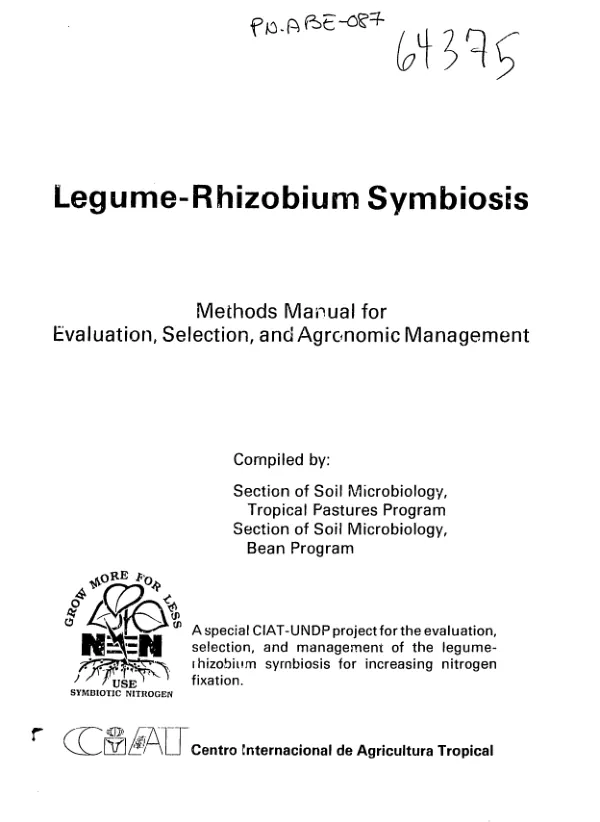
Legume - rhizobium symbiosis : methods manual for evaluation, selection, and agronomic management
Sign inINTERNATIONAL CENTER FOR TROPICAL AGRICULTURE (CIAT)
Legume - rhizobium symbiosis : methods manual for evaluation, selection, and agronomic management
The purpose of this manual is to describe methods available for studies in rhizobiology applicable to tropical agriculture, particularly those for tropical forage legumes and beans.
Sylvester-Bradley, Rosemary, comp.; Kipe-Nolt, Judy, comp. · 1988
Sign in to readA free account is required to download.
Abstract
More emphasis is given to applied studies, and no attempt has been made to cover all methods available for studying rhizobia. There are several books on methods for studying N2 fixation for those who require more information (Bergersen, 1980; Vincent, 1970; IAEA, 1983; FAO, 1983; Somasegaran and Hoben, 1985). We believe that this manual complements the other publications available, because it emphasizes the agronomic aspects of evaluating the symbiosis. This manual complements the audiotutorial unit entitled Legume-Rhizobium Symbiosis: Evaluation, Selection and Management, which describes some aspects of the most important basic characteristics of the symbiosis, and introduces the concepts required for the use of the methods presented here in detail. The objectives and selection stages used in a legume selection program should be defined in close collaboration between the microbiologist, and those responsible for the agronomic evaluation. The ultimate objective of this work is to select legume-rhizobium combinations which show a high N2-fixing capacity under local conditions. The first chapter reviews the concepts presented in the audiotutorial unit. The relationship between the different chapters in the manual and the evaluation stages is also described. Examples are included of selection strategies for forage legumes and beans. Chapters 2 through 20 contain descriptions of the methods per se and three appendices. The first appendix describes a cheap and simple transfer chamber for laboratory work, designed by the NifTAL project; the second describes the acetylene reduction method which can be used in some cases for making relative estimations of nitrogenase activity; and the third lists strains recommended for inoculation of beans and tropical forage legumes in different ecosystems. (Author abstract)