USAID. MISSION TO LESOTHO
Lesotho agricultural production and institutional support (LAPIS)
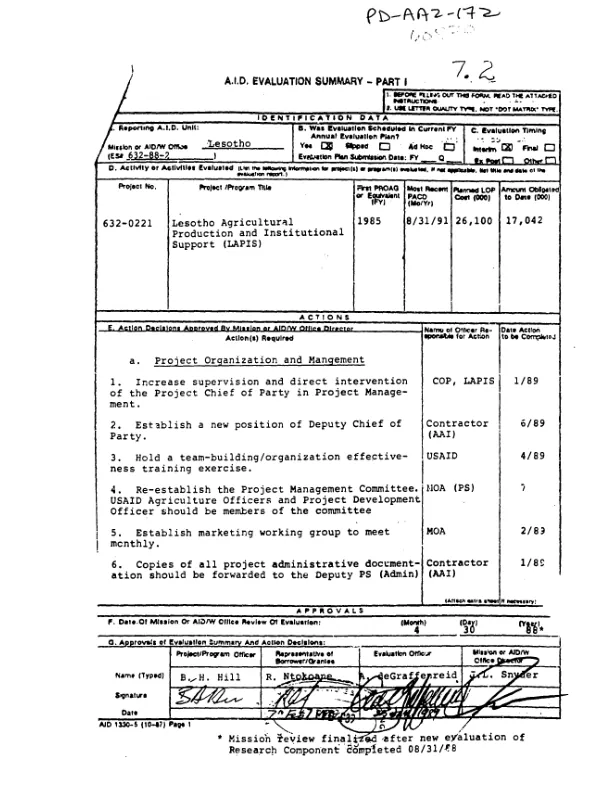
Summarizes attached final evaluations (XD-ABH-027-A, -B, -D, -E) of a project (1985-4/93) to assist Lesotho"s Ministry of Agriculture (MOA) in the areas of agricultural production, research, and education.
1993
Sign in to readA free account is required to download.

Abstract
The evaluations focused on sustainability and institutionalization, the emphases of the project after the 1988 evaluation. Results were mixed. Long- and short-term training was the most successful activity and the one generally most beneficial to MOA institutional strengthening. Still, resources are lost when personnel with advanced degrees return to the Ministry and are frustrated by low incentives and inadequate operating support. The range management area and home gardens programs were also successful -- the former due to a grassroots approach which left decisionmaking in the hands of the grazing associations, the Range Management Division"s commitment to the program, and the smooth integration of project advisors within the Livestock Department; the latter because it used local farmers to impart appropriate gardening and nutrition skills in a manner that strengthened farmer and community self-reliance. Finally, although the project focused on high-value horticultural crops, the major achievements of the research component were agronomic (adaptation and promotion of pinto beans and Tugela wheat), indicating the greater relevance of agronomic crops to subsistence farmers. The production credit program was unsuccessful and was terminated in 12/89. The failure was due to the self-defeating methodology of directing the investment decisions of the Lesotho Cooperative Credit Union League (LCCUL) and overwhelming its capacity with large sums of money while at the same time encouraging it to be more self-sufficient. In fact, the credit program was fraught with problems from the start: rural credit unions perceived the project as using them for its own ends instead of helping them become self-sustaining, while LCCUL saw the project solely as a means of obtaining donor financial assistance. Sustainability and institution-building efforts at the MOA"s Research Division have been frustrated by weak government commitment to agricultural research in general, which has resulted in the long-term dependence of research on donor assistance. In sum, the sustainability of the project"s initiatives during the current period of reduced budgets will depend on their actual or perceived accomplishments, MOA commitment, and the availability of funds. Lessons learned are as follows. (1) Technologies for the small Mosotho farmer should be "low-tech," exploit the range (often small) of possibilities for improving existing cultivation or husbandry practices, and introduce new varieties that address constraints in a way compatible with the totality of farmer practices (including dietary preferences) and capacities. (2) It was unrealistic to expect traditional subsistence farmers to make a quick transition to capital-intensive commercial farming. (3) Given the Basotho familiarity with farm animals (vs. their relative unfamiliarity with commercial vegetable farming), expansion of intensive livestock production (fat lambs, broilers, pigs) seems to hold better promise for commercialization. (4) The original project design showed insufficient understanding of the realities of both agricultural development and Lesotho, which resulted in a considerable cost in money, time, and opportunity. The realignment in 1989 did a good deal better, although it took an inordinate amount of time to design and did not clarify some issues (e.g., definition of a small farmer). (5) Future programs should heed this project"s example and plan integrated programs of attitudinal change, TA, credit, capital investment, and marketing, and allow enough time for these elements to come together. Institution-building efforts must take indigenous social realities into account and limit activity costs to replicable levels. (6) Uncoordinated donor programs are often counterproductive. The major action decision is to extend the PACD 2 years to complete intensive livestock production activities.