USAID. MISSION TO LESOTHO
Lesotho agricultural production and institutional support (LAPIS)
Summarizes interim evaluations (XD-AAZ-172-A and -B) of a project to strengthen the agricultural research and extension capabilities of Lesotho"s Ministry of Agriculture (MOA) and to provide direct production and marketing assistance to small farmers.
1989
Sign in to readA free account is required to download.
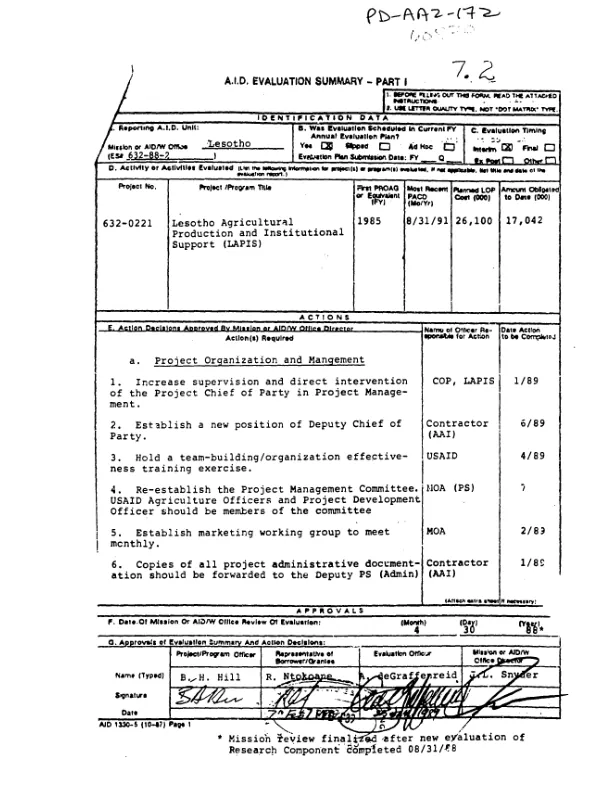
Abstract
Evaluation covers the period 8/85-5/88. In operation for only a year and a half, the project met its quantifiable targets, though not all its institutional objectives. Irrigated crop production goals have been exceeded, with 39 individual farmers and 2 farmer associations (totaling 70 members) participating; efforts to market project-supported crops have been less sucessful. The education component is well organized and has upgraded academic standards at the Lesotho Agricultural College (LAC). Long-term training of LAC faculty and the marked increase in practical hands-on training have addressed some of the program"s basic weaknesses. However, LAC needs to raise teacher salaries to prevent the loss of trained staff to other institutions. In all, the project has placed 38 persons in U.S. universities for B.Sc. or advanced degree training, and participant monitoring and progress reporting have been commendable. The highly qualified, effective TA team was able to mobilize shortly after contract negotiations and undoubtedly contributed to these achievements. Project implementation has suffered from attempting to simultaneously strengthen the MOA structurally, while sending a large number of MOA professional staff overseas for long-term training. Moreover, there has been evidence of MOA dissatisfaction with the project"s focus on individual farmers as opposed to cooperative production strategies. The MOA has not provided adequate personnel to support the project, especially in the field, and needs to create an institutional structure to coordinate and stimulate support for smallholder commercial production. It is recommended that USAID/L review the relevance of the project to current Government of Lesotho policies. The farming systems research component has not contributed as expected to project objectives, primarily due to disagreement among project management regarding its appropriateness.