USAID DEC
Lessons from Scaling-up HIV Viral Load Testing in Tanzania: The Importance of Monitoring the HVL Cascade
Sign inELIZABETH GLASER PEDIATRIC AIDS FOUNDATION
Lessons from Scaling-up HIV Viral Load Testing in Tanzania: The Importance of Monitoring the HVL Cascade
HIV viral load (HVL) testing in Tanzania has experienced a significant increase since 2017, driven by the expansion of testing laboratories and the hub-and-spokes model for sample transportation and processing.
1 pages
Sign in to readA free account is required to download.
Abstract
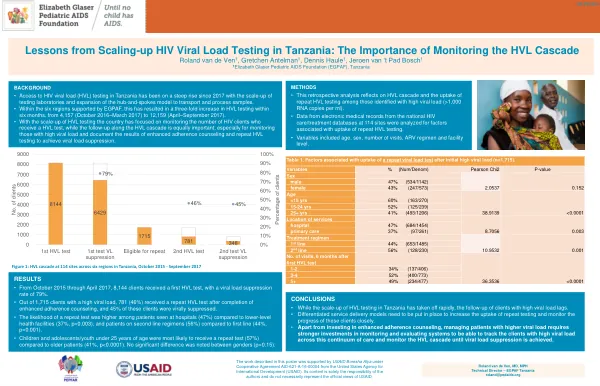
Within the six regions supported by the Elizabeth Glaser Pediatric AIDS Foundation (EGPAF), HVL testing has risen from 4,157 tests between October 2016 and March 2017 to 12,159 tests between April and September 2017, representing a three-fold increase. The scale-up of HVL testing has led to a focus on monitoring the number of HIV clients who receive a HVL test. However, follow-up along the HVL cascade is equally important, particularly for monitoring those with high viral load and documenting the results of enhanced adherence counseling and repeat HVL testing to achieve viral load suppression. From October 2015 through April 2017, 8,144 clients received a first HVL test, with a viral load suppression rate of 79%. Out of 1,715 clients with a high viral load, 781 (46%) received a repeat HVL test after completion of enhanced adherence counseling, and 45% of these clients were virally suppressed. The likelihood of a repeat test was higher among patients seen at hospitals (47%) compared to lower-level health facilities (37%), and patients on second-line regimens (56%) compared to first-line regimens (44%). Children and adolescents/youth under 25 years of age were most likely to receive a repeat test (57%) compared to older patients (41%). No significant difference was noted between genders. The analysis highlights the importance of monitoring the HVL cascade and the need for differentiated service delivery models to increase the uptake of repeat testing and closely monitor the progress of clients with high viral load. The study's findings suggest that managing patients with higher viral load requires stronger investments in monitoring and evaluating systems to track clients with high viral load across the continuum of care and monitor the HVL cascade until viral load suppression is achieved. The analysis also underscores the need for enhanced adherence counseling and repeat HVL testing to achieve viral load suppression. The study's results have implications for the development of effective HIV treatment and care programs in Tanzania and other countries.