USAID DEC
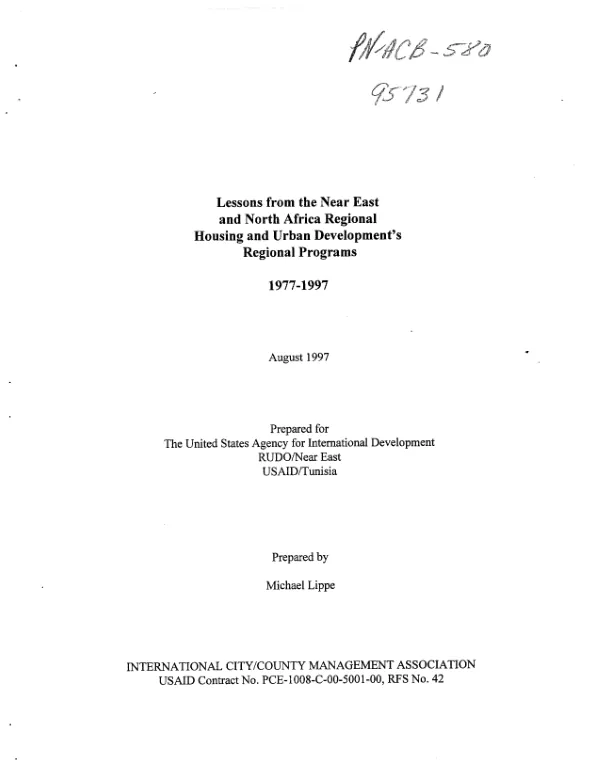
Lessons from the Near East and North Africa regional housing and urban development's regional programs, 1977-1997
Sign inINTERNATIONAL CITY/COUNTY MANAGEMENT ASSOCIATION (ICMA)
Lessons from the Near East and North Africa regional housing and urban development's regional programs, 1977-1997
From 1977 until 1997, USAID's Near East and North Africa (NENA) Regional Housing and Urban Development Office (RHUDO), based in Tunisia, managed an information exchange and training program involving all countries in the region.
Lippe, Michael · 1997
Sign in to readA free account is required to download.
Abstract
This report describes the program and draws lessons learned, with emphasis on the period after 1992, when RHUDO synthesized a formal regional training strategy, to which it provided resources on a systematic basis. Program activities included regional policy seminars; formation of collaborative relationships with regional and international organizations, including the International Union of Local Authorities (IULA) and the United Nations Center for Human Settlements (UNCHS); training workshops involving more than one country; exchange visits within the region; and a widely distributed newsletter. Probably the most significant and certainly a unique activity was the establishment of a regional NGO, called the Regional Advisory Council (RAC), as a vehicle for advancing enlightened urban policies. Originally intended to serve RHUDO in an advisory capacity, the RAC has taken on an independent life and a new name, the NENA Urban Forum, and will continue after RHUDO's departure to act as an independent nongovernmental body concerned with defining a regional urban agenda. Overall, the RHUDO regional program was a success, made possible by a number of elements: the strong sense of Arabic solidarity, as well as a common language and colonial experience; the sense that the program was locally inspired, with strong local input; RHUDO's devotion of considerable human but only modest financial resources to the program; the involvement of other multilateral and bilateral donors; and RHUDO's use of successes from its Tunisian program. The following lessons were learned. (1) Establishing a successful regional program requires an understanding of the region and careful preparation and assessment. The selection of participants and the choice of topics to be covered must reflect the results of this assessment, not merely the wishes of the donor. (2) In matching countries in a regional information and training exchange program the key criterion is what the countries can learn from each other. Countries that are less similar in terms of language and culture should be combined with countries that are more similar from an institutional or policy vantage point. (3) A successful program requires the sponsoring RHUDO or other entity to make regional activities a priority. It is far too easy to relegate these kinds of activities to the end of the line in terms of resource allocation. (4) Using an ongoing program in one country as a base of operations and as a learning laboratory for regional exchanges and seminars is strongly recommended. (5) The involvement of other donors lessens the financial burden on any one organization and helps lead other donors to understand and pursue the same policy goals. However, this collaboration needs to be closely monitored to ensure that goals are reached and that the policies being promoted are the ones USAID supports. (6) Local involvement is crucial. The NENA model of a Regional Advisory Council was key to this involvement. In the Near East, it appears to have had the added advantage of structuring a sustainable policy organization. (Author abstract, modified)
Related documents