USAID DEC
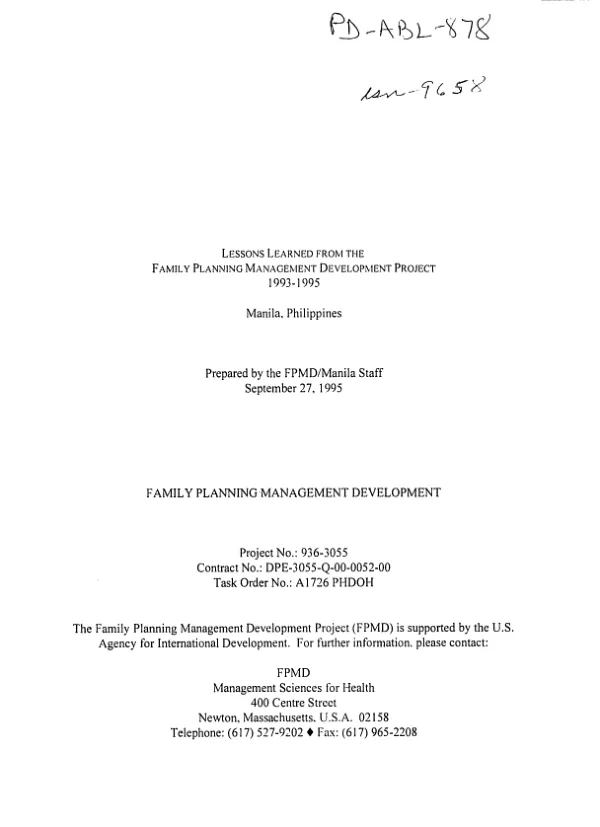
Lessons learned from the family planning management development project -- 1993-1995, Manila Philippines
Sign inMANAGEMENT SCIENCES FOR HEALTH (MSH)
Lessons learned from the family planning management development project -- 1993-1995, Manila Philippines
Evaluates the Local Government Unit (LGU) Performance Program (LPP), a component of the Integrated Family Planning (FP) and Maternal Health Program in the Philippines.
Vian, Taryn|Villa, Eireen · 1995
Sign in to readA free account is required to download.
Abstract
The LPP provided performance-based grants and TA to LGUs based on their achievement of yearly benchmarks in decentralized provision of FP services. Evaluation covers the period 1993-95. In the area of program start-up, LPP assisted the Department of Health (DOH) in selecting and training LGUs and their staff. A total of 30 LGUs participated in LPP during 1994-1995, with 400 local, national, and regional personnel benefiting from 12 workshops in LPP requirements, technical and management aspects of the program, FP policies and strategies, etc. In addition, several guides for LGU managers were produced and disseminated. LGU management development activities have included: guidance in and subsidies for the conduct of local planning meetings; more than 180 TA and monitoring visits to LGUs; establishment after consultation with all concerned parties of start-up and capacity-building performance benchmarks for years 1-3 of the program; establishment of planning standards, review guidelines, and a review committee, along with a system for monitoring benchmarks and LGU performance; and assistance to the DOH in documenting achievement of benchmarks, resulting in the disbursement of the equivalent of some $3 million in performance grants in 1995. Efforts in building management capacity at the national level have included establishment of a high-level LPP Advisory Committee to consider policy and program decisions; studies on the roles and responsibilities of the regional offices and the DOH program management structure; and provision of policy guidance on a variety of issues ranging from the promotion of natural family planning to the definition of terms such as Married Women of Reproductive Age. Lessons learned are detailed in three categories: factors that make local governments successful implementors; performance-based disbursement; and sustainability. Lessons regarding success factors are as follows: (1) The commitment of the local chief executive (governor, mayor) and of senior health/population staff is an important, though difficult to measure, ingredient of success. (2) The LPP coordinator can be equally effective regardless of whether he/she is from the Population, Health, or the Program Planning and Development Office. (3) Broad participation at the LGU level is necessary for decentralized management to work. (4) A process-oriented approach to building LGU management capacity works better than task- or program-oriented assistance. (5) Clear national-level guidance on policies and standards is essential for effective program implementation. The role of national services is to develop this information and monitor its application in the field. (6) Close monitoring and intensive TA are required at the start, and yield results. (7) Provinces must have clear and collaborative relationships with municipalities. Lessons regarding performance-based disbursement: (1) Not all LGUs have equal capacity; hence, creating common performance indicators can be difficult. (2) Plans based on budget allocations set in advance promote accountability. (3) Performance grants need to reward good performance. (4) Successful implementation of plans and achievement of benchmarks depends on prompt receipt of funds. (5) Management by benchmark does not replace all other management decision making needs. (6) Benchmarks can provide management objectives that work. (7) LGUs that do not perform must be held accountable. Lessons on sustainability. (1) Regional offices must adopt greater responsibility for LPP implementation and management. (2) LPP must be perceived as owned by the Philippines, not as donor-driven. (3) The DOH should harmonize approaches for donor assistance to LGUs in the areas of FP, child survival, and population. (4) The Commission on Population (POPCOM) and regional/local population offices need to be further integrated into LPP processes. (5) Implementation must go forward at a pace that permits adequate monitoring of DOH and benchmark compliance. (6) DOH services must assume greater responsibility for TA, plan review, and monitoring of program/plan implementation at the LGU level.
Related documents
![Evaluation report : FPMD [family planning management development] assistance in Bangladesh](https://covers.devme.ai/gen/16366.webp)