USAID. MISSION TO ECUADOR
Letter grant agreement : project OPG 518-0064, no. 518-0064-G-00-7257-00
OPG to the Fundacion Nuestros Jovenes (FNJ), an indigenous Ecuadorean PVO, to increase awareness of drug problems and to influence government policy on drug production, trafficking, and abuse through a program of research and information dissemination.
1987
Sign in to readA free account is required to download.
Abstract
To strengthen FNJ"s capacity to fight Ecuador"s drug problems, the project will fund long- and short-term TA and staff training in planning, financial and personnel management; contracting; and computerization (including establishment of a drug data base). FNJ will establish volunteer community outreach programs in 6 provinces. FNJ will conduct three types of research: (1) an epidemiological survey of drug abuse (by age group, geographical region, socioeconomic/cultural groups) and of public awareness of drug problems and their consequences; (2) approximately 30 case studies, key informant interviews, and analyses of sociological variables correlated with different aspects of the drug problem; and (3) applied research, (to be conducted through a grant program open to universities, doctors, journalists, and students) by Drug Information Centers which will be established by FNJ in Quito and Guayaquil. FNJ"s information dissemination and public awareness activities will be the responsibility of the Drug Information Centers, which will: (1) establish drug information telephone hotlines, (2) sponsor television documentaries, (3) hold seminars, conferences and meetings with parents, politicians, law enforcement officials, etc., (4) publish and disseminate drug education materials, (5) advertise the hotline and display messages on billboards, (6) provide TA and information to concerned community organizations; and (7) support FNJ"s provincial outreach programs. The Centers will also collect and catalogue relevant secondary sources on drug problems, including professional publications, research materials, and related documents from within and without Ecuador. FNJ will provide observational trips to the United States and third countries, seminars, and on-the-job training to Center staff and volunteers. FNJ will also develop a plan to enable the Centers to attain some measure of financial self-sufficiency by the end of the project, through, e.g., service fees.
Related documents
Documents in this collection
 1993
1993USAID DEC
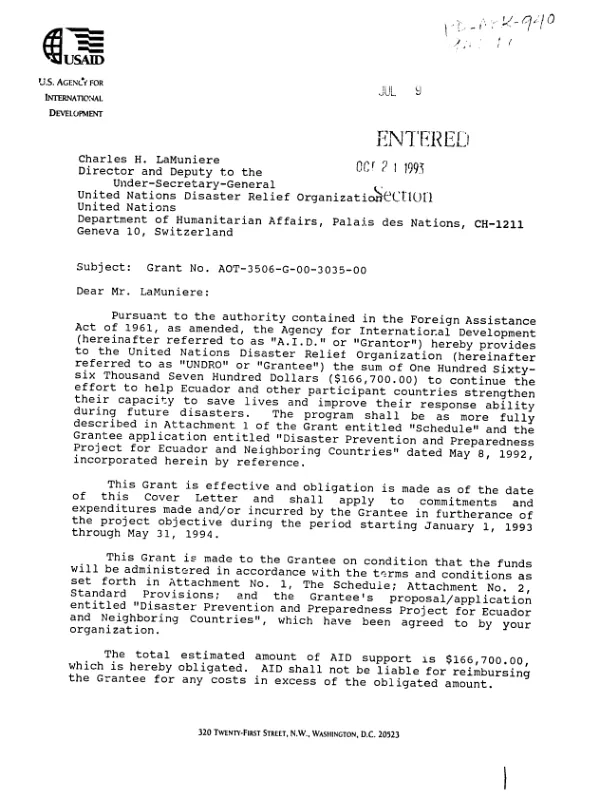
AID grant no. AOT-3506-G-00-3035-00 to the United Nations Disaster Relief Organization (UNDRO) to support the `Disaster prevention and preparedness project for Ecuador and neighboring countries`
Open record 1990
1990USAID DEC
![Cooperative agreement no. LAC-0518-A-00-1055-00, amendment no. 13 [to the International Planned Parenthood (Ecuador)]](https://covers.devme.ai/gen/37891.webp)