USAID DEC
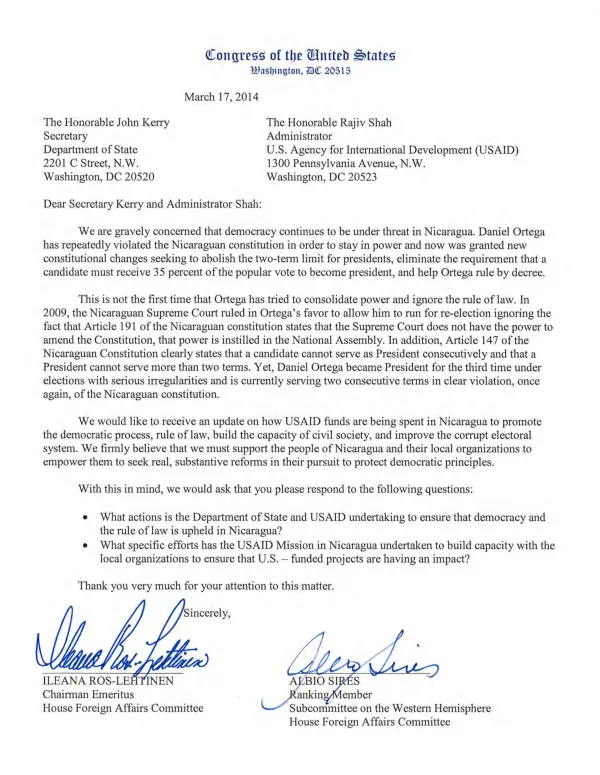
Letter to the Honorable John Kerry and Administrator Shah regarding democracy in Nicaragua
Sign inU.S. DEPARTMENT OF STATE/OES
Letter to the Honorable John Kerry and Administrator Shah regarding democracy in Nicaragua
The Nicaraguan government, led by President Daniel Ortega, has been criticized for violating the country's constitution.
2014 · 2 pages
Sign in to readA free account is required to download.
Abstract
Ortega has been granted new constitutional changes that abolish the two-term limit for presidents, eliminate the requirement that a candidate must receive 35 percent of the popular vote to become president, and allow Ortega to rule by decree. This move is seen as an attempt to consolidate power and ignore the rule of law. In 2009, the Nicaraguan Supreme Court ruled in Ortega's favor, allowing him to run for re-election despite the fact that the Supreme Court does not have the power to amend the Constitution. Article 191 of the Nicaraguan Constitution states that the power to amend the Constitution is held by the National Assembly. Additionally, Article 147 of the Constitution clearly states that a candidate cannot serve as President consecutively and that a President cannot serve more than two terms. Despite this, Ortega became President for the third time under elections with serious irregularities and is currently serving two consecutive terms in clear violation of the Nicaraguan constitution. The US government has expressed concern over the situation in Nicaragua and has called for an update on how USAID funds are being spent in the country to promote the democratic process, rule of law, build the capacity of civil society, and improve the corrupt electoral system. The US government believes that it is essential to support the people of Nicaragua and their local organizations to empower them to seek real, substantive reforms in their pursuit to protect democratic principles. The US Department of State and USAID are undertaking various actions to ensure that democracy and the rule of law are upheld in Nicaragua. These actions include building capacity with local organizations to ensure that US-funded projects have an impact. The USAID Mission in Nicaragua has undertaken specific efforts to build capacity with local organizations, including providing training and technical assistance to help them develop their skills and abilities. The US government is also working to improve the electoral system in Nicaragua by providing support to civil society organizations and promoting transparency and accountability in the electoral process. The goal is to ensure that the electoral process is free, fair, and transparent, and that the will of the Nicaraguan people is respected.
Related documents