FLORIDA INTERNATIONAL UNIVERSITY
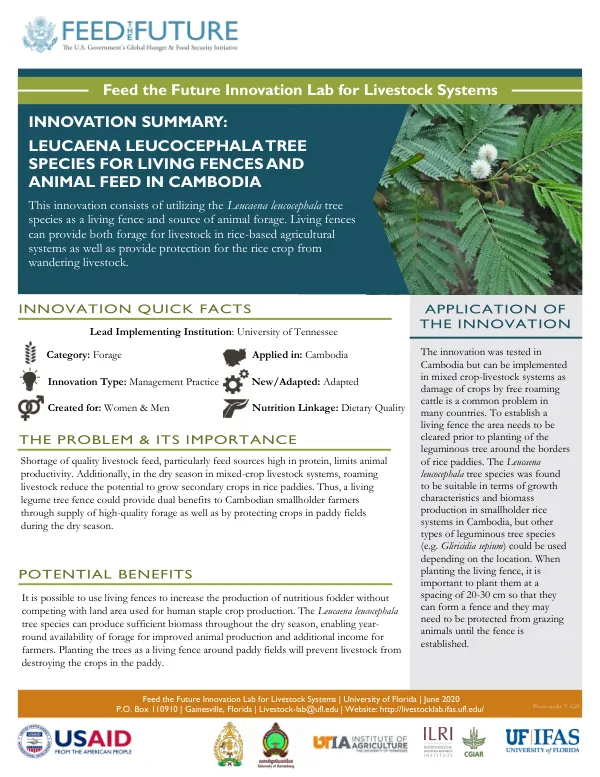
Leucaena leucocephala tree species for living fences and animal feed in Cambodia
The Leucaena leucocephala tree species has been identified as a suitable option for living fences in mixed-crop livestock systems.
2020 · 1 pages
Sign in to readA free account is required to download.
Abstract
This innovation provides a dual benefit to smallholder farmers by supplying high-quality forage for livestock and protecting crops in paddy fields during the dry season. The tree species can produce sufficient biomass throughout the dry season, enabling year-round availability of forage for improved animal production and additional income for farmers. Living fences can provide both forage for livestock in rice-based agricultural systems as well as protection for the rice crop from wandering livestock. The Leucaena leucocephala tree species was found to be suitable in terms of growth characteristics and biomass production in smallholder rice systems in Cambodia. However, other types of leguminous tree species, such as Gliricidia sepium, could be used depending on the location. To establish a living fence, the area needs to be cleared prior to planting the leguminous tree around the borders of rice paddies. The trees should be planted at a spacing of 20-30 cm to form a fence and may need to be protected from grazing animals until the fence is established. The innovation was tested in Cambodia but can be implemented in mixed crop-livestock systems as damage of crops by free-roaming cattle is a common problem in many countries. The Leucaena leucocephala tree species can produce high-quality forage, particularly during the dry season when other feed sources are scarce. This can lead to improved animal productivity and additional income for farmers. The innovation has the potential to address the shortage of quality livestock feed, particularly feed sources high in protein, which limits animal productivity in many countries. The implementation of living fences using the Leucaena leucocephala tree species can be adapted to various locations and can be beneficial for both women and men smallholder farmers. The innovation can be integrated into existing agricultural systems, providing a sustainable solution to the challenges faced by smallholder farmers in mixed-crop livestock systems.
Related documents
Documents in this collection
 2018
2018USAID DEC
Final Report: Safe Food, Fair Food for Cambodia project: Report on food safety risk assessment for informal value chains training conducted in Cambodia, 15 to 17 January 2018
Open record 2018
2018USAID DEC