USAID DEC
Feed the Future Innovation Lab for Livestock Systems in Cambodia: Priorities and Research Projects
Sign inINTERNATIONAL LIVESTOCK RESEARCH INSTITUTE
Feed the Future Innovation Lab for Livestock Systems in Cambodia: Priorities and Research Projects
Livestock Systems Innovation Lab (LSIL) for Cambodia was established by the University of Florida (UF) Institute of Food and Agricultural Sciences (IFAS) with funding from the U.S.
2018 · 7 pages
Sign in to readA free account is required to download.
Abstract
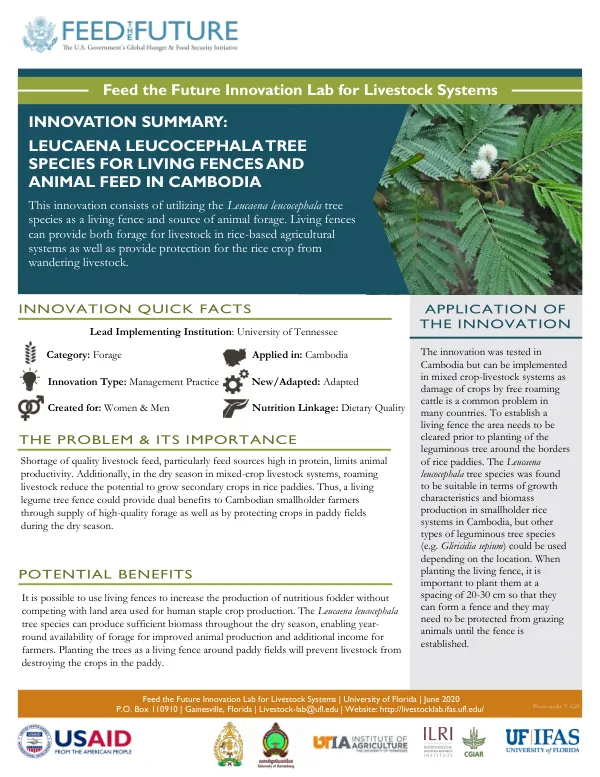
Agency for International Development (USAID). The five-year initiative, which began in October 2015 and concluded in September 2020, aimed to improve the nutrition, health, and incomes of the poor by sustainably increasing livestock production and marketing, and consumption of animal-source foods (ASF). The LSIL collaborated with the International Livestock Research Institute (ILRI) to implement the Livestock Systems Innovation Lab (LSIL). The organization's primary goal was to introduce new location-appropriate technologies, improve management practices, skills, knowledge, and access to and quality of inputs across livestock value chains. Additionally, LSIL supported the development of a policy environment that fosters sustainable intensification and increased profitability of smallholder livestock systems. The LSIL drew on the expertise of the target country, U.S., and foreign universities, institutes, and organizations through competitively-funded, long-term, multi-disciplinary, integrated applied research and capacity-building projects. The organization's project portfolio included Reach, Focus, Catalyst, and Strategic Partnership projects. Reach projects were competitively-funded, larger projects with up to $1,000,000 in funding and a duration of up to four years. Focus projects were competitively-funded, smaller projects with up to $150,000 in funding and a duration of up to one year. In Cambodia, the LSIL received four applications for Focus projects, which were reviewed and approved through a similar process as the Reach proposals. Two projects were selected for funding: Improved Pig Health and Nutrition, led by the Major Drivers of Profitability and Sustainability for Small Farmers in Cambodia, and Living Fences for Improved Livestock Feed in Cambodian Smallholder Systems. The LSIL also conducted a multi-stakeholder Innovation Platform meeting in Phnom Penh on July 7-8, 2016, to develop research priorities for Cambodia. A total of 38 individuals from the Royal Government of Cambodia, NGOs, private organizations, universities, and research institutes participated in the meeting. The meeting aimed to identify priorities for research and capacity building in Cambodia. The LSIL also supported the development of a policy environment that fosters sustainable intensification and increased profitability of smallholder livestock systems. The organization's research priorities for Cambodia included ASF production and marketing, livestock disease management and food safety, and enabling policies and future systems. The Safe Food, Fair Food for Cambodia project, led by Dr. Delia Grace of ILRI, aimed to assess the multiple burdens of foodborne diseases associated with key Animal-Source Food (ASF) value chains in Cambodia. The project investigated the links between nutrition and food safety in the context of ASF and aimed to reduce the burden of foodborne disease in informal, emerging formal, and niche markets targeting small and medium-scale producers. The project had five objectives, including generating actionable evidence on the health and economic burden of foodborne diseases associated with ASF in Cambodia, developing and testing a market-based approach to improving food safety, and enhancing engagement and benefit sharing for men and women in value chains. The project also aimed to build capacity in food safety risk, its management, and effective communication among stakeholders. The outcomes of the project included greater awareness among policymakers, donors, and the private sector of the multiple burdens of foodborne disease and their implications. The project also aimed to reduce the burden of foodborne disease in informal, emerging formal, and niche markets targeting small and medium-scale producers.
Related documents